
This Article is written by Ankit Mohanty of Soa National Institute of Law.
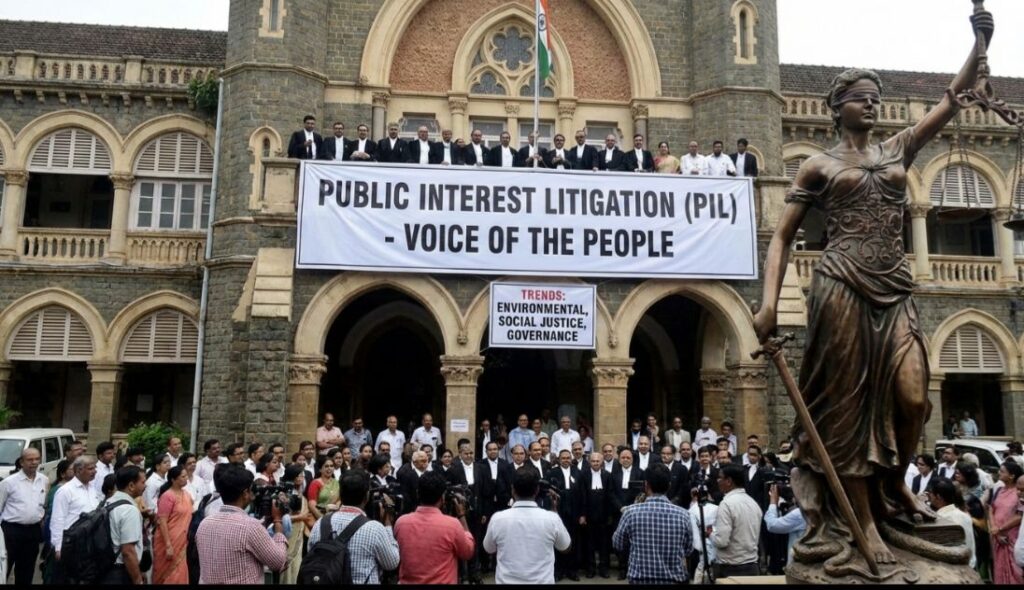
Public Interest Litigation (PIL) has drastically changed the landscape of access to justice for citizens in India by “democratizing access to justice for marginalized groups” and “proactively enforcement of fundamental rights.” Born out of cases filed first at the Indian Supreme Court in the late 1970s in cases such as Hussainara Khatoon vs. State of Bihar (1979), which pioneered “Epistolary Jurisdiction” by treating letters as writ petitions, PILs circumvented usual rules on “locus standi” to endow judiciary with greater powers to aid society against public wrong. For decades, High Courts have been thrust into a central position under Article 226 due to growing caseloads on a wide range of public issues. As the first line of defense against violations of constitutionalism, they address state-specific issues, such as prison reforms, bonded labor, environmental protection, and climate change vulnerabilities, among others, often issuing continuing mandamus for compliance. As a law student interested in judicial activism trends, this article endeavors to look at the evolution in High Court PILs till early 2026. Against the backdrop of NJDG-reported pendency of more than 62 lakh cases in April 2025, it looks at the recent spikes in climate, privacy, and education PILs; landmark orders such as the Bombay HC’s Arpora demolition order and the Madras HC’s EIA mandates on climate; and reforms aimed at combating frivolous filings and vacancies 354 judges, 32% shortfall.
Historical Evolution
It is to be noted that PILs began in High Courts as an extension of Supreme Court rulings relaxing the requirement to have locus standi in cases such as Hussainara Khatoon v. State of Bihar (1979), and High Courts adopted PILs on issues pertaining to human rights, the environment, and governance, and among High Courts, the PIL on workplace harassment began in the Bombay High Court and culminated in Vishaka guidelines issued in its case against the State of Rajasthan (1997).The subject of PIL in the 2010s centered on bonded labor abolition and environmental protection. The improvement in waste disposal rates exceeded 83.7% in 23 High Courts in 2021, decreasing pendency from 10,985 to 9,772 cases. It empowered High Courts as “courts of the people” while adopting a liberal interpretation of Article 21.
Constitutional Framework
The jurisdiction of High Courts in Public Interest Litigation emanates from Article 226 of the Constitution of India to issue writs for the enforcement of fundamental rights. High Courts’ jurisdiction is different from Section 32 of the Supreme Court because they deal with specific state matters in a wider. Landmark judgments such as the Bandhua Mukti Morcha case attained this by mandating just conditions under Article 42. Continuing mandamus for compliance is also ordered by the courts.
Recent Trends: 2024-2026
High Court PILs surged in climate, privacy, and education amid 4.69 crore district pendency driving upward litigation. According to NJDG data, at the end of April 2025, High Courts have a pendency of 44 lakh civil and 18 lakh criminal cases each; PILs are one of the major subsets. Delhi High Court heard the PILs on digital lending privacy (2026) and IndiGo cancellations (Dec 2025) and refused to entertain duplicates to avoid multiplicity. Allahabad High Court declined PILs pertaining to new legislation (Sep 2025) and construction violations, 2025.
The Bombay High Court was moving in the direction of much finer scrutiny by insisting on security deposits in cases of “bona fide” PILs and, wherever possible, converting suits to PILs, such as the Arpora construction (2025). The Madras High Court ordered climate assessments in EIA (2024, continuing). Climate PILs started cropping up in huge numbers, really reflecting global trends localized within India.
Challenges and Criticisms
Frivolous PILs were termed as ‘Publicity Interest Litigation,’ which is a great threat to the judiciary as it is based on motivated pleas instead of genuinely public interest. As a result, there are stringent rules laid to ensure that PILs are devoid of personal interests for the petitioner and are not based on political motives, as observed by the Bombay High Court in the year 2022 with the observation that security deposits must be paid. Although it has been projected that the full strength would be sufficient to dispose of the backlogs in the High Courts in the next 20 years, the backlogs continue to rise owing to a judge vacancy figure of 354 judges (a sanction gap of 32% as of May 2025). Errors in the reporting of data by NJDG have contributed to the backlogs. Overextension by the judiciary increases the scope of executive encroachment. Stagnation in the lower judiciary continues to the tune of 4.69 crore cases.
Reforms and Way Forward
The courts emphasize the need for judicial training programmes. There is need for open judicial management and rules such as the 2010 PIL Guidelines formulated by the Bombay High Court that require the filing of affidavits indicating personal interests, undertaking the cost if the petition is frivolous, and Division Bench hearings for PILs to prevent their abuse. There is Supreme Court direction for the 2-month rule for the disposal of bail matters that can be followed for urgency in the case of PILs. Digital enhancements to NJDG, such as real-time tracking and AI triage, along with filling existing vacancies of 354 judges/trial court judges currently (32% shortfall as of May this year), can also cut down on pending cases.
Conclusion
Public Interest Litigation in the High Courts has evolved considerably since its advent in the Supreme Court in the latter part of the 1970s, with the landmark case of Hussainara Khatoon, to an indispensable device for the effective enforcement of Articles 21 and 14 with the rise of climate change, privacy, education, and governance matters till early 2026. Recent landmark actions by the High Courts, like the Bombay HC in the Arpora demolition case, the Madras HC in the climate change mandates pursuant to the Environmental Impact Assessment rules, the Delhi HC in the IndiGo case, the Allahabad HC in the abetment standards case (PIL 2985/2025), highlight the reach of PIL activity with the checks of the quantity of affidavits, security deposits, duplicate. Despite this, the road to reform is fraught with hurdles: a pending count of 62 lakhs in the High Courts for the year 2025, a backlog of 4.69 crores in the districts, a shortage of 354 judges for a slew of judicial vacancies, or the Publicity Interest misuses, which are threatening to subvert the balance altogether. Yet, the solutions issues related to a watershed of rules related to PILs, like the Bombay High Court Rules of 2010. If struck in balance, PILs in India’s High Court system have significant potential for sustaining their traditional role as courts of the people.
Frequently Asked Questions
What ignited PIL jurisdiction in High Courts?
PILs have their roots in Supreme Court decisions such as Hussainara Khatoon, which bestowed High Courts with powers akin to Articles 226 in giving Epistolary jurisdiction. High Courts, beginning with the Bombay and Delhi High Courts, have taken on issues of prison reform, bonded labor, and the environment, which have become enforcement tools for Articles 21 and 14.
Why are climate PILs rising in High Courts?
Filings, therefore, skyrocketed after 2024 on the flaws of EIA and urban pollution, with Madras HC ordering pre-EIA climate assessments. That is a local effect-like flooding-aligned with global trends but fitted for state vulnerabilities under Article 21’s right to a clean environment.
What is the role of High Court PIL rules?
Attempts to reduce backlog: Filling up 354 vacancies out of a total of 1106 vacancies amounting to 32%, triaging through AI at NJDG, continuous judicial training, uniform guidelines, and the SC mandating disposal in two months.
What are some possible reforms to reduce pendency in High Court PILs?
Filling 354 vacancies i.e., 32% as on 2025, AI-based NJDG model, Judicial Training, and nationwide uniform PIL guidelines. Extension of 2 months’ timeframe for PIL cases to Supreme Court will boost efficiency with limited judicial excess.
References
- NJDG High Court Pendency Data. National Judicial Data Grid. https://njdg.ecourts.gov.in/hcnjdg_v2/. Last visited: January 25, 2026.njdg.ecourts
- Bombay High Court Public Interest Litigation Rules, 2010. LegitQuest. https://www.legitquest.com/act/bombay-high-court-public-interest-litigation-rules-2010/8A9D. Last visited: January 25, 2026.legitquest
- India Justice Report 2025: Judge Vacancies and Pendency. New Indian Express. https://www.newindianexpress.com/nation/2025/Apr/15/only-15-judges-per-million-population-in-the-country-2025-india-justice-repo…. Last visited: January 25, 2026.newindianexpress
- Hussainara Khatoon v. State of Bihar (1979) 1 SCC 81. Supreme Court of India. https://testbook.com/landmark-judgements/hussainara-khatoon-vs-state-of-bihar. Last visited: January 25, 2026.testbook
- High Court Judge Vacancies (330 as of Sep 2025). New Indian Express. https://www.newindianexpress.com/nation/2025/Oct/03/across-india-only-two-high-courts-fully-staffed-allahabad-tops-with-76-vacan…. Last visited: January 25, 2026.
- National Judicial Data Grid (NJDG), High Court Pendency Data (April 2025), https://njdg.ecourts.gov.in/hcnjdg_v2/.
- Bombay High Court Public Interest Litigation Rules, 2010, https://www.legitquest.com/act/bombay-high-court-public-interest-litigation-rules-2010/8A9D.
- India Justice Report 2025: Judge Vacancies, The New Indian Express (Apr 15, 2025), https://www.newindianexpress.com/nation/2025/Apr/15/only-15-judges-per-million-population-in-the-country-2025-india-justice-report.
- Hussainara Khatoon v. State of Bihar, (1979) 1 SCC 81, https://indiankanoon.org/doc/257876/.
- Vishaka v. State of Rajasthan, (1997) 6 SCC 241, https://indiankanoon.org/doc/1031794/.