This article is written by Namrata Jana of Fakir Mohan University, Balasore, Orissa
The Indian Judiciary has played a crucial role in interpreting and enforcing environmental laws, adjudicating disputes, safeguarding environmental rights and shaping environmental governance.
The Supreme Court acknowledges that United Nations Conference on Human Environment and the Stockholm Conference in 1972 played a significant role in raising Environment consciousness and establishing the Idea of sustainable development as a part Customary International law. It has outlined several principles of sustainable development.
Evolution of Environmental Law Doctrines by Judiciary
- Doctrine of Absolute liability – The doctrine of Absolute liability is a legal principle in tort law that holds a person or entity strictly liable for harm caused by hazardous or dangerous activities, without any exceptions or defenses. In Union Carbide corporation vs Union of India, the Supreme Court of India established the
doctrine of Absolute liability. The court held that when an enterprise engages in inherently dangerous or hazardous activities, it is strictly and absolutely liable for any harm caused as a result of accident in such operation. - Polluter pays principles – The underlying principle is that is a person, or entity pollutes the environment, they are responsible for bearing the costs associated with the pollution and its clean up
In Vellore citizens welfare forum vs Union of India, in this case, Supreme Court of India, affirmed the polluter pays principle is an integral part of sustainable development. - “Precautionary principle” –The precautionary principle means “better safe than harm” it advises that if something might cause harm, even if we don’t have full proof, we should take precautions to prevent damage before it happens. Vellore citizens forum case– The Supreme Court of India outlined 3 key aspects of precautionary principle. Environment measures should aim to anticipate prevent and address the cause of environmental degradation.
A lack of scientific certainty should not be used as a reason to postpone
necessary measure. Finally, the burden of proof lies with party undertaking an action to demonstrate its being nature. These principles guide decision making in situation where potential harm to the environment exists. - “Public Trust Doctrine” – The public trust doctrine is based on the principles that certain resources, such as air, water, sea and forest are of significant important to society as a whole and shouldn’t be subject to private ownership government has a duty to protect and maintain these resources for benefits of the public. So, the government act as a trustee of certain natural resources and cannot give them away or
misuse them for private or commercial interests of it harms the public rights.
M.C Mehta vs Kamal Nath and others, in this case, the Supreme Court held that the public trust Doctrine is an inherent part of the law of the land. This doctrine ensures that these resources are protected and managed in the interest of the public. “Doctrine of Sustainable development” This doctrine ensures that “development meets the needs of the present without compromising the ability of future generations to meets their own needs” The concept of sustainable development was highlighted by the world commission on Environment and development (WCED) in its report, commonly known as the Bratland Report.
Environmental rights Recognized by Judiciary
The Active role of the Judiciary in Environmental protection is evident in several key Judiciary, which are summarized below:
- The Right to wholesome Environment
In the Charan Lal Sahu Case, The Supreme Court recognized that the right to life guaranteed by article 21 of the Constitution includes the Right to a wholesome Environment.
Damodhar Rao vs Municipal corporation Hyderabad case, The Court relied on Constitutional mandates under Article 48A and 51(g) to assert that environmental pollution would violate the fundamental rights to life and personal liberty enshrined in Article 21. - Public Nuisance: The Judicial Response
Ratlam Municipal Council vs Vardhi hand case, The Supreme Court judgement emphasized the social justice component of the rule of law, it held statutory authorities liable to fulfill their obligations in bating public Nuisance and making the environment pollution – free, even if there are budgetary constraints. This case also recognised PIL as a Constitutional Obligations of the Courts. - Judicial Relief Encompasses Compensation to Victims – Delhi gas leak case (M.C. Mehta vs Union of India), the Supreme Court established 2 important principles of law. Firstly – it confirmed the power of the Court to grant remedial relief, Including compensation, for proven infringement of Fundamental rights such as Article 21.
Secondly, it Introduced the concept of “no fault” liability (Absolute liability) for industries engages in hazardous activities, which significantly impacted liability and compensation laws in India - Fundamental Rights to Water
The Fundamental Right to water in India has evolved through Judicial Interpretation. In the Narmada Bachao Andolan vs Union of India and Others case, the Supreme Court upheld that water is a basic need for human survival and an implicit part of the right to life, human rights, the right to a healthy environment and sustainable development as enshrined in Article 21.
Recent Judicial interpretation in Environmental law
Recent Judicial interpretation in environmental law Include the Supreme Court emphasizing due process by quashing penalties against Benzo Chem due to insufficient evidence and remanding cases Grasim Industries due to procedural lapses. Other key decisions involve ensuring that State Environment Impact Assessment Authorities
are established in all states and appointing committees to recommend restoration measures for damages ecosystem. The judiciary has also reinforced long – standing principles like Sustainable development and
the Polluter pays principles and broadened interpretation of constitutional rights to include a clean and healthy environment.
Benzo Chem Industrial Private Limited vs Arvind Manohar Mahajan & Ors. The Supreme Court overturned penalties imposed by the National Green Tribunal (NGT) on Benzo Chem, finding the NGT’s evidence insufficient and contrary to reports from the Maharashtra Pollution Control Board and NEERI, which confirmed the company’s compliance.
Grasim industries Limited vs State of Madhya Pradesh – The Supreme Court remanded cases back to the NGT, citing procedural lapses where Grasim Industries was not a party to the proceedings and was not given a chance to be Heard before penalties were imposed.
Conclusion
Judicial interpretation plays a decisive role in shaping and advancing environmental law. As environmental challenges grow more complex, courts increasingly serve as essential arbiters in clarifying statutory ambiguities, balancing competing public interest and ensuring that legislative and regulatory goals are effectively implemented. Through doctrines such as the precautionary principle, sustainable development and public trust, judges have expanded the substantive and procedural Protection available within environmental Governance.
Moreover, judicial interpretation acts as a critical mechanism for holding governments and private actors accountable when regulatory frameworks fall short or enforcement is lacking. Courts not only interpret the text of environmental statutes but also give life to Constitutional environmental rights where they exist, strengthening citizens’ access to justice and promoting transparency in environmental decision making.
Frequently Asked Questions
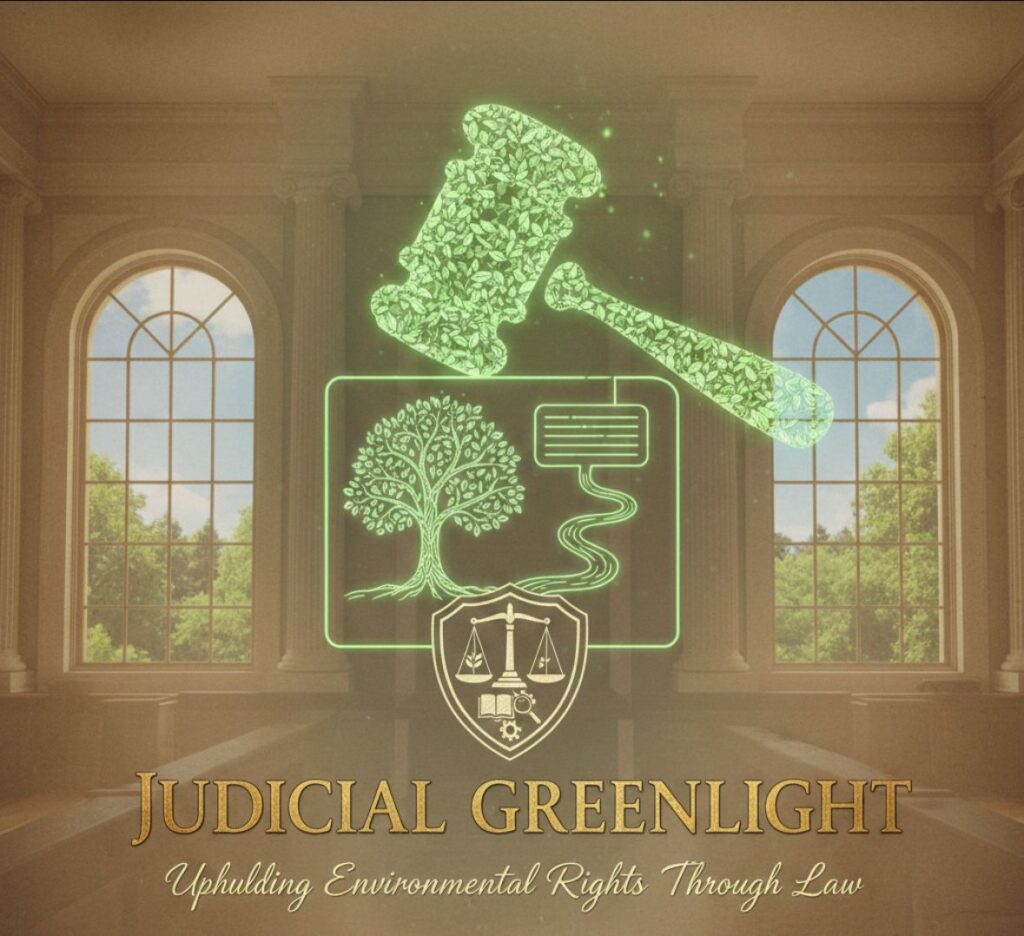
What is meant by “Judicial Greenlight” in environmental law?
Judicial Greenlight refers to the proactive role played by courts in protecting and enforcing environmental rights through legal interpretation, judicial review, and landmark judgments.
How do courts uphold environmental rights through law?
Courts uphold environmental rights by interpreting constitutional provisions, enforcing environmental statutes, applying principles like sustainable development, and ensuring accountability of both the state and private actors.
Why is the judiciary important in environmental protection?
The judiciary acts as a guardian of environmental rights by providing remedies against environmental degradation, filling legislative gaps, and ensuring that development does not come at the cost of ecological balance.
What legal principles are commonly applied by courts in environmental cases?
Courts often apply principles such as the precautionary principle, polluter pays principle, public trust doctrine, and intergenerational equity.
How does judicial intervention contribute to sustainable development?
Judicial intervention ensures that economic growth is balanced with environmental protection, promotes responsible governance, and secures a clean and healthy environment for present and future generations.
References