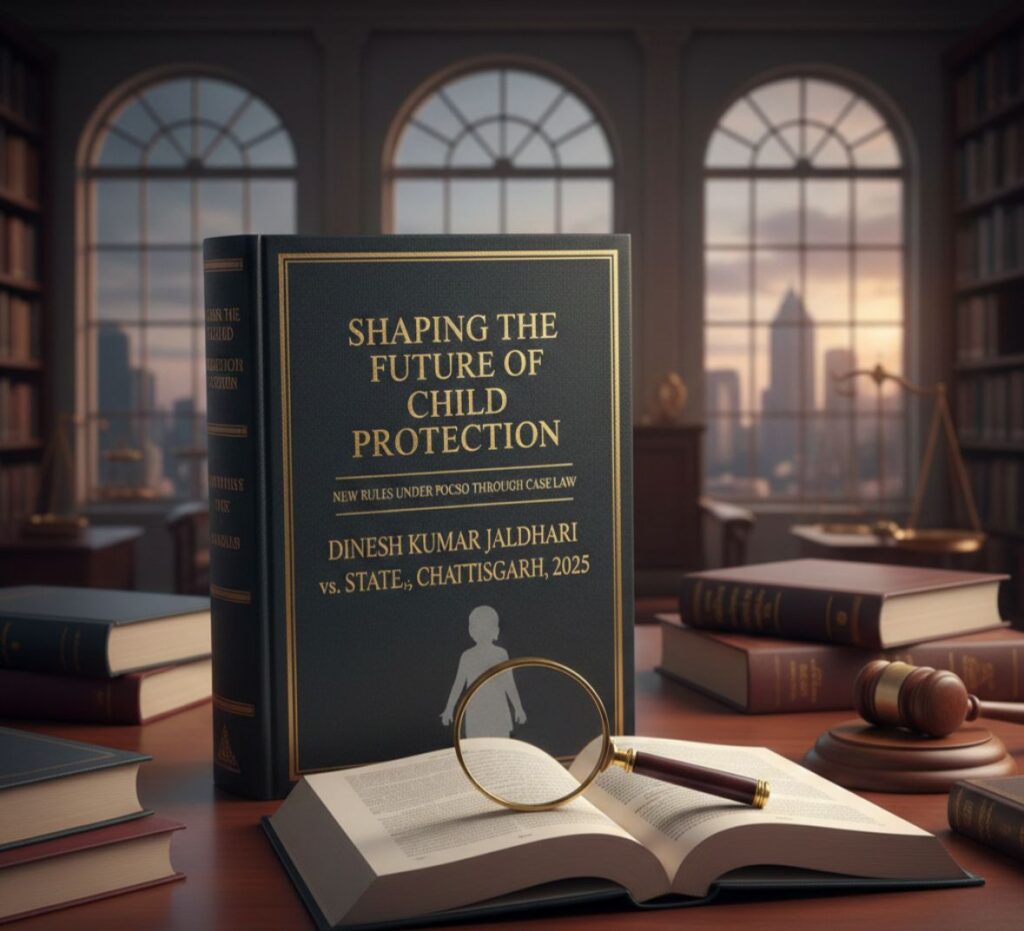
“Shaping the Future of Child Protection: New Rules under POCSO through Case Law”
This article is written by Namrata Jana of Fakir Mohan University, Balasore, Orissa
The Protection of Children from Sexual Offences (POCSO) Act ,2012 is a special law enacted by the Indian Parliament to protect children from all sexual abuse and exploitation. Recently the Supreme Court of India has Interpreted the POCSO Act (Protection of Children from Sexual Offences Act) through its judgement – Including important principles, clarification and controversies – “Dinesh Kumar Jaldhari vs. State of Chhattisgarh (2025)
Upheld the conviction of the appellant under Section 9(m) and 10 of the Protection of Children from Sexual Offences Act,2012(POCSO ACT) while reducing the sentence from seven years to six years of rigorous imprisonment, considering the period already served.
Why in News?
The Supreme Court upheld the conviction of a man found guilty of aggravated sexual assault on a 4 – year – old girl, rejecting his plea for acquittal based on the absence of medical evidence and eyewitness testimony, holding that the consistent and credible evidence of the child’s Parents was sufficient to sustain the conviction. The bench of Justices Arvind Kumar and c. V. Anjaria in the case of Dinesh Kumar Jaldhari vs State of Chattisgarh (2025) upheld the conviction of the appellant under Section 9(m) and 10 of the Protection of Children from Sexual Offences Act ,2012(POCSO Act) while reducing the sentence from seven years to six years of rigorous imprisonment, considering the period already served.
What was the Background of Dinesh Kumar Jaldhari vs. State of Chattisgarh (2025) Case?
Incident Details:
The Incident took Place on 15 August 2021. The child’s mother woke up to find the accused, wearing only Shorts, sitting near her sleeping daughter. When she questioned him, he ran away. She noticed: her daughter’s clothes were disturbed, the child was crying and in pain, and her private parts were wet. A medical examination showed redness in the vagina area, but no external injuries or bleeding. The girl’s birth certificate confirmed she was 4 years old.
Legal Proceedings:
FIR No. 52 of 2021 was registered at Duldula Police Station, Jashpur under IPC Section 376, 376B and POCSO ACT Sections 5 and 6. The victim underwent medical examination, and her statement was recorded under Section
164 CrPC. The appeal was filed by Dinesh Kumar Jaldhari, convicted by a Special POCSO Court in Kunkuri and whose Conviction was later upheld by the Chhattisgarh High Court. The appellant had been sentenced to seven years of rigorous imprisonment under Section 9(m) read with Section 10 of the POCSO Act a provision dealing with aggravated sexual assault on a child below 12. The Prosecution’ s case, briefly was built on the mother’s testimony. On 15 August 2021, she reportedly walked into her house around 4:30 pm and found the appellant sitting near the legs of her four – year – old daughter, wearing only a half – short. The child’ s underwear was
lowered, the frock pushed up , and she was crying in pain. The mother later told the police that the child complained of pain in her private parts.
An FIR followed the same day, and the medical examination noted redness in the private area, though no external injuries or bleeding. While the defence insisted this weekend the prosecution, the trial court believed the consistency of the parents account outweighed the gaps.
Trial and High Court
Both Parents testified in court and their statements matched each other on all important points. The trial court found their evidence reliable and convicted the accused for aggravated sexual assault under Sexual 9(m) and 10 of the POCSO Act, sentencing Him to 7 years of rigorous imprisonment. The Chhattisgarh High Court upheld this district in March 2025.
What were the Court’s Observation?
Consistent Witness Testimony:
The Victim’ Parents (PW- 2 and PW-3) provided consistent and detailed Accounts of the incident.
The mother testified finding the appellate in compromising circumstances with the child’s underwear pulled down to her knees and frock pulled up to the chest.
Medical Evidence:
Dr. Priyanka Toppo (PW- 6) noted redness in the vagina, though no external injuries or bleeding were found.
The Court held that medical Evidence takes a backseat when ocular evidence is
consistent and cogent.
Child Victim’ s Behavior as Evidence:
During Testimony on 16th November 2021.
When shown the accused with his mask removed, the victim (PW- 1) became frightened and refused to look at him.
The accused had to be sent out, and evidence recording was stopped.
After multiple attempts, the 4-year – old victim continued crying and could not speak, leading to closure of her Examination.
Court’s Decision:
The accused argued that: – there were no eyewitnesses, the medical report did not show injuries and therefore, the case was doubtful. But The Supreme Court rejected these arguments. Bench said that medical evidence is
secondary when Ocular (eye- witness) evidence is clear, consistent and trustworthy. The Court also relied heavily on the behavior of the child when she was brought to court. As soon as She saw the accused without a mask. The Court observed: The fact that the victim was in a frightened state upon seeing the accused is a pointer in itself. The shock related to the happening of the Incident which continued with the victim post- incident made its statement in the trauma – filled behavior of the victim who was a 4 year – old girl. The Supreme Court upheld the conviction recorded by the Trial Court and affirmed by the High Court, finding the appreciation of evidence to be eminently legal and proper, warranting no interference”.
While upholding the conviction, the Court reduced the sentence from 7 years to 6
years of rigorous imprisonment.
The appellant had already undergone imprisonment for approximately 4 years and 5
months at the time of the judgement.
The fine amount was modified to Rs. 6000/- with simple imprisonment of one year in
default of payment.
Conclusion
The judiciary’s intervention has significantly strengthened the POCSO Act’s implementation by ensuring child- centric justice, closing legal loopholes, demanding institutional accountability and reinforcing the principles that the welfare and dignity of the child are paramount. These steps collectively make the legal framework more robust, responsive and effective in combating child sexual abuse in India.
Frequent Asked Questions
What was the core legal issue in this case?
The central legal question involved the sufficiency of circumstantial evidence and parental testimony for an aggravated sexual assault conviction under the POCSO Act when direct evidence from the young victim was limited.
What laws were primarily involved?
The case primarily involved the POCSO Act, specifically Sections 7, 8, 9(m), and 10.
How did the victim behave in court?
The victim became distressed upon seeing the accused and could not provide a verbal statement.
References