This Article is written by Aishwarya Jain of DES’s Shri Navalmal Firodia Law College, Pune.
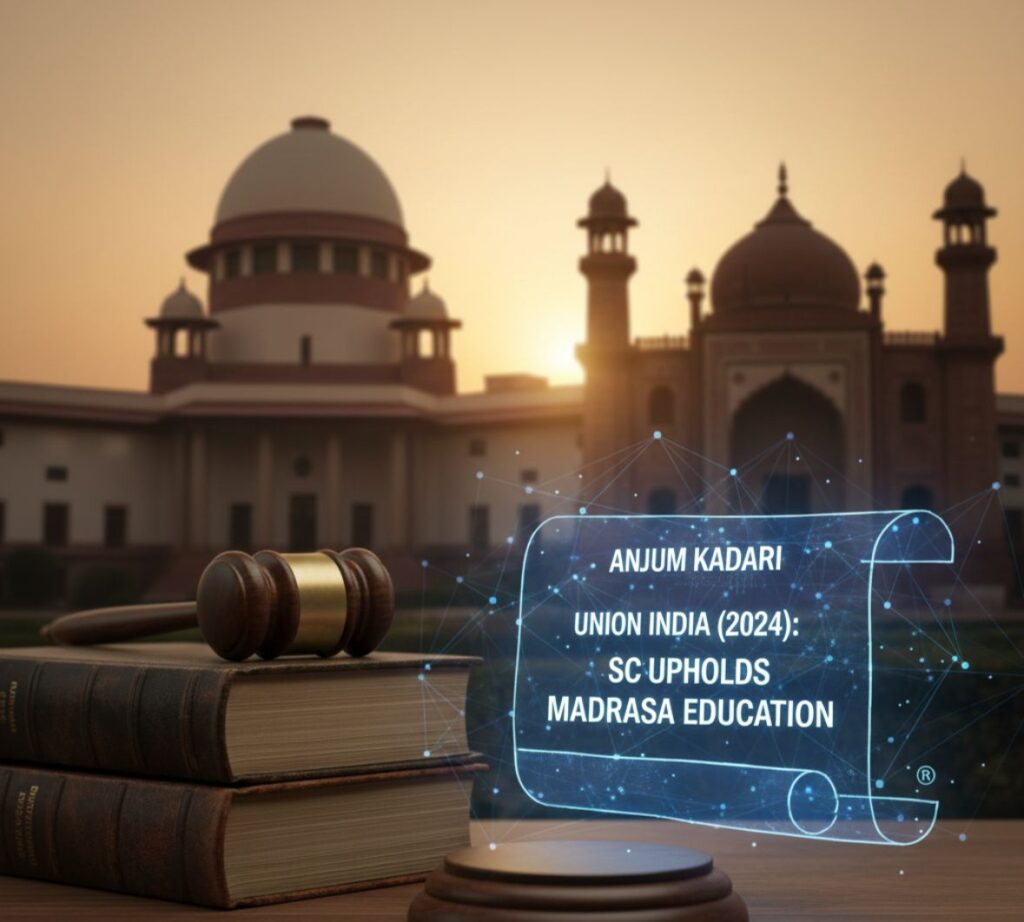
The landmark ruling in Anjum Kadari v. Union of India (2024 INSC 831) by the Supreme Court of India tackles a crucial and delicate matter at the nexus of education, minority rights, and secularism. The Uttar Pradesh Board of Madarsa Education Act, 2004 (“Madarsa Act”), a state law that governs Madarsa education in Uttar Pradesh, was challenged as unconstitutional. Muslim students predominately attend madarsas, which are traditional educational establishments. More than 12 lakh students are taught by more than 13,000 Madarsas in Uttar Pradesh alone. These institutions offer secular education in subjects like science, math, and languages at elementary, secondary, and even higher levels in addition to religious instruction. The entire Madarsa Act was overturned by the Allahabad High Court in March 2024, citing violations of the Constitutional Principles of Secularism, Fundamental Rights under Articles 14 (Equality), 21 (Life and Liberty), and 21A (Right to Education), as well as a conflict with Section 22 of the University Grants Commission Act, 1956 (UGC Act). The High Court
further mandated that the State Government move all Madarsa kids to regular schools that have State Education Board accreditation. This decision caused widespread anxiety, particularly in relation to minorities’ access to an education. The matter reached the Supreme Court through several Special Leave Petitions. On 5 November 2024, a three-judge Bench comprising Chief Justice D.Y. Chandrachud, Justice J.B. Pardiwala and Justice Manoj Misra issued a detailed verdict. The Court maintained the Madarsa Act and reversed the High Court’s ruling, except for sections related to higher education degrees that were found to contradict central legislation. This decision is
significant as it clarifies the interpretation of the Indian Constitution regarding secularism, minority rights, and educational governance, particularly in a diverse nation like India.
CASE LAWS AND LEGAL ISSUES INVOLVED
In order to establish a statutory board that would oversee Madarsa operations, the Uttar Pradesh Board of Madarsa Education Act, 2004 was passed. Ensuring minimum educational standards, prescribing curricula, administering tests, and recognizing Madarsa-issued certificates were the goals.
The Allahabad High Court ruled that the Act was unconstitutional in March 2024. The High Court reasoned that: Secularism, a component of the Constitution’s Basic Structure, was violated by the
Act. By treating Madarsa students differently, it violated Article 14. It was in conflict with the University Grants Commission Act, 1956 because Madarsas were granting higher education degrees like Kamil and Fazil; it also allegedly violated Articles 21 and 21A by denying students a proper education. The Supreme Court received petitions from people who felt wronged by this ruling.
SUPREME COURT’S ANALYSIS AND REASONING
- Can a Law Be Struck Down for Violating Secularism Alone?
One of the most important observations made by the Supreme Court was that a law cannot be struck down merely for violating abstract constitutional principles, such as Secularism, Democracy, or Federalism. Courts must identify the specific constitutional provision that has been violated even though these concepts are part of the basic framework. The Court noted that ideas such as secularism are broad and ambiguous. If judges began to declare laws unconstitutional based on such vague standards, legal ambiguity would ensue. Therefore, unless a statute was passed without legislative authority or manifestly violates a
constitutional clause, it cannot be overturned. - Religious Education vs. Religious Instruction
The Supreme Court drew an important distinction between teaching religious rituals and practices (Religious Instruction), and imparting knowledge of a religion’s ideals, history, and philosophy (Religious Education). The Court explained, citing Article 28 of the Constitution, that although religious instruction cannot be taught in establishments that receive all of their funding from the state, this does not preclude the state from recognizing or regulating establishments that offer religious instruction in addition to secular education. Madarsas frequently teach both religious and secular subjects, the Court ruled, and this does
not contradict the Constitution. Promoting religion does not equate to state recognition or regulation. - Madarsa Act and Minority Rights (Article 30)
The Court emphasized that Minority Rights are an essential part of Indian Secularism. Under Article 30, minorities have the right to establish and administer educational institutions of their choice.
According to the Supreme Court, true Secularism does not mean strict separation of religion and State, but rather equal respect and support for all religions. The State has a positive obligation to ensure that minority institutions are able to provide quality education while maintaining their unique identity. The Madarsa Act was seen as furthering substantive equality, as it helps students studying in Madarsas attain minimum educational standards and improves their ability to participate effectively in society. - The Madarsa Act as a Regulation Law
The Supreme Court rejected the notion that the Madarsa Act was meant to promote religious instruction. Instead, it came to the conclusion that the Act is a regulatory statute that was enacted to improve educational standards.
The Court stated that the State has a right to ensure that all educational establishments, including minority institutions, maintain a minimal level of academic excellence. Curriculum, test, and teacher certification regulations are permissible as long as they don’t compromise the institution’s minority character. Consequently, it was concluded that the Madarsa Act complied with constitutional standards.
- Article 21A’s Right to Education
The Madarsa system of education, according to the Allahabad High Court, violated Article 21A, which ensures free and compulsory education. In contrast, the Supreme Court made it clear that minority educational institutions are exempt from the Right to Education Act, 2009 (RTE Act). The purpose of this constitutionally permissible exemption is to safeguard the rights of minorities. The Madarsa Act offers adequate regulatory mechanisms to guarantee that children receive high-quality education, the Court added. - The State’s Legislative Authority
Whether the State of Uttar Pradesh had the authority to pass the Madarsa Act was another
significant question. According to the Supreme Court, the Act is covered by Entry 25 of List III (Concurrent List), which addresses education. The presence of religious elements in education does not take the law outside the State’s legislative competence. If education containing religious instruction were excluded, it would directly undermine Article 30, which expressly allows minorities to establish educational institutions.
Thus, the State Legislature was fully competent to enact the Madarsa Act. - Conflict with the UGC Act and Higher Education Degrees
The Supreme Court partially agreed with the High Court regarding higher education degrees.
It concluded that:
Entry 25 of List III is subject to Entry 66 of List I.
The UGC Act, 1956 is enacted under Entry 66 of List I, which deals with
coordination and determination of standards in higher education.
The State cannot regulate higher education degrees that fall under the UGC’s purview.
As a result, the Madarsa Act’s sections pertaining to degrees like Fazil (postgraduate level) and Kamil (bachelor’s level) were declared illegal. However, the Court used the Doctrine of Severability to find that these clauses are separate. As a result, only the higher education-related clauses were repealed; the Act’s other provisions remain in force.
CONCLUSION
The judgment in Anjum Kadari v. Union of India (2024) is a thoughtful and balanced decision that reinforces India’s constitutional values. The Supreme Court successfully protected Minority Rights, upheld the importance of Educational Regulation, and clarified the meaning of Secularism in the Indian context. By setting aside the Allahabad High Court’s sweeping invalidation of the Madarsa Act, the Supreme Court ensured that lakhs of students studying in Madarsas are not abruptly displaced from their educational institutions. At the same time, by striking down provisions relating to higher education degrees, the Court maintained the supremacy of national standards in higher education. Overall, this judgment reflects a Pragmatic and Inclusive Constitutional Approach, reminding us that secularism in India is about coexistence, not exclusion.
Frequently Asked Questions
1. What was the main issue in Anjum Kadari v. Union of India (2024)?
The main issue was whether the Uttar Pradesh Board of Madarsa Education Act, 2004 is constitutional.
2. Did the Supreme Court strike down the entire Madarsa Act?
No. The Supreme Court upheld most of the Act and struck down only those provisions dealing with higher education degrees.
3. Why were Kamil and Fazil degrees declared unconstitutional?
Because regulation of higher education falls under the UGC Act, which is a central law under the Union List.
4. Does the Madarsa Act violate secularism?
No. The Supreme Court held that regulating Madarsas does not violate secularism and is consistent with minority rights.
References
https://www.livelaw.in/tags/anjum-kadari-and-another-v-union-of-india