This article is written by Reeba Banday
We all go to work with many goals in mind, like earning a livelihood, building a career, and to be respected as professionals. In return, every person is entitled to one essential, fundamental thing for their time and talent: absolute security and dignity. Yet historically, the workplace has not been a safe space for many people in India. Sexual harassment was widespread, and the fear of retaliation often silenced victims, as speaking up risked an individual’s job or reputation. This painful reality forced the creation of a legal framework starting with the deeply disturbing case of Bhanwari Devi, a social worker who was violently assaulted to prevent a child’s marriage. Her fight for justice exposed the severe lack of legal protection for working women. As a result, the Supreme Court issued the landmark Vishaka Guidelines in 1997, which mandated that employers must prevent sexual harassment. These guidelines acted as law for 16 years. Recognizing the need for a stronger, formal system, the government then enacted the Sexual Harassment of Women at Workplace (Prevention, Prohibition and Redressal) Act, 2013 (POSH Act). While we are rightly fighting for these basic rights for women, we must also open our eyes to a larger truth: men are also harassed, and people who are gender nonconforming (not just men or women) also suffer the same kind of unfair abuse.
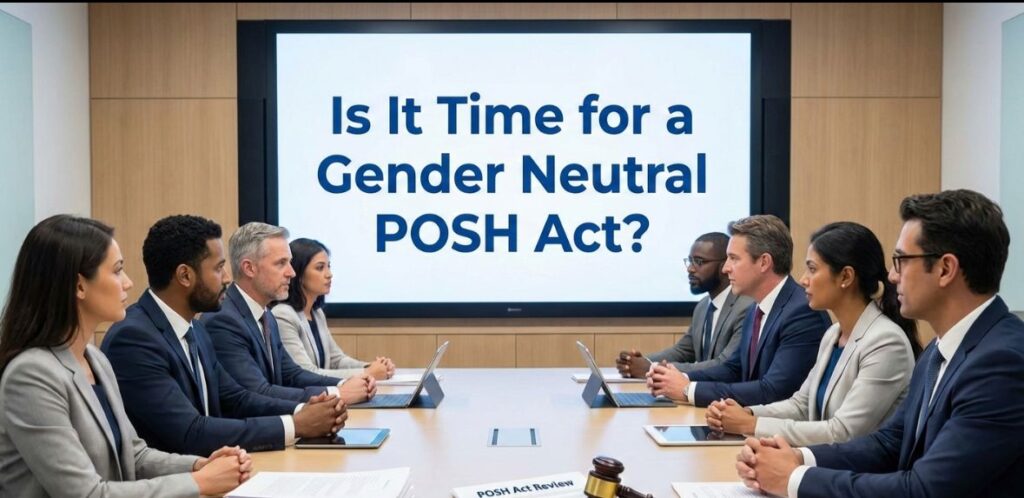
As a lawyer, I must state this clearly: The POSH law exists to protect the basic dignity that our Constitution promises to everyone in India. If the goal is to protect dignity, then that protection must cover everyone. The POSH Act is important and should never be weakened. But its protective shield must be made wider to match the way our world works today. The law needs to change from being a historic defense for just one gender to being a basic, universal right for every single employee.
Gender-Based Limitation
The main limitation of the POSH Act lies in its definition of who can file a complaint. Section 2(a) states that only an “aggrieved woman” can be a complainant. This creates a legal barrier. Men and other genders, like transgender, cannot use the special remedies provided under the Act. This limitation made sense at the time of the Vishaka judgment, as the case focused on protecting women at the workplace. However, in today’s context, this creates a serious problem. Sexual harassment is not limited to one gender. It is essentially an abuse of power, which can be committed by anyone in a position of authority, regardless of gender. Therefore, the law should
focus on the wrong act itself, not only on the gender of the person who suffers from it.
Constitutional Equality and the Problem of Exclusion
The POSH Act protects only women. Male victims are therefore not covered by this legal remedy. This raises serious constitutional concerns under Articles 14 and 21, which guarantee the right to equality and the right to live with dignity. If the law demands equality and fairness for women, it should also provide the same protection to men. Equality cannot work for one gender alone. When a law treats two groups differently, that difference must be reasonable and connected to the purpose of the law. The purpose of workplace harassment laws is to protect dignity at work. Today, excluding men from such protection cannot be justified. The need for gender neutral laws was also suggested by the Justice Verma Committee report in 2013. Protection of workplace dignity should be available to everyone, regardless of gender. Similarly, the right to a dignified workplace belongs to all persons, including the recognition of rights for transgender persons. When the law does not give male victims a proper and effective remedy, it reduces the value of their dignity at work. This goes against the basic promise of the Constitution. Legal scholars have consistently argued that gender-neutral laws are needed to protect all victims of workplace harassment.
Why Male Victims Struggle to Get Justice
When a man faces harassment at work, the current system doesn’t give him good options. There are mainly two paths, but both have some kind of issues. For women, the POSH Act gives the Internal Committee (IC) strong legal powers. It can call witnesses, ask for documents, and make sure the investigation is fair. For men, the IC loses these powers. It becomes just a company team following internal rules. The process depends on the employer, not the law. This makes it hard for men to get fair treatment. Men can also file a police case under laws like the Bharatiya Nyaya Sanhita (BNS). But criminal law is slow, public, and focused on punishment. Workplace harassment often needs quick, private solutions like mediation, transfers, or warnings. Going through criminal court can harm a man’s career and mental health without really fixing the workplace problem.
Men’s Right to Safety
The question is not whether men can protect themselves. The real question is about their rights and remedies. Every person at work has the right to feel safe and respected, but right now, the law doesn’t fully protect men. Imagine a man being harassed by his boss. He can’t just leave the job; he needs it to live. And yet, there is no proper legal way for him to report it or get help. That’s the problem. Society often tells men to be strong, silent, and “handle it.” But harassment is not about strength; it’s about power, control, and abuse. Men should have the same right as anyone else to stop harassment, get justice, and continue their work without fear. Some companies are trying to change, making rules that protect everyone, regardless of gender. That’s good, but company policies are not enough. The law itself must change. The POSH Act should call every victim an “aggrieved person,” not just women. This simple change would make a huge difference; it would give men clear legal protection, real remedies, and the confidence to speak up. Everyone deserves to work in a safe, respectful place. Genders should never decide who gets justice. Men’s voices, their dignity, and their safety matter just as much. It’s time for the law to recognize that.
CASE LAWS
The Supreme Court has consistently held that sexual harassment is a violation of dignity at the workplace. In Apparel Export Promotion Council v. A.K. Chopra, the Court clarified that any behaviour which harms an employee’s dignity amounts to sexual harassment.
In NALSA v. Union of India, the Court recognised transgender persons and affirmed that constitutional rights under Articles 14 and 21 apply to everyone, regardless of gender identity.
This idea was strengthened in Justice K.S. Puttaswamy v. Union of India, where dignity, autonomy, and privacy were declared essential parts of the right to life.
Further, in Anuj Garg v. Hotel Association of India, the Court warned against laws based on outdated gender stereotypes, holding that unequal protection violates Article 14. Together, these judgments show that workplace dignity is a constitutional right for all persons,
not just one gender.
Conclusion
Work is not just a place to earn money; it’s where we spend most of our time, grow, and contribute. Everyone, no matter their gender, deserves to feel safe, respected, and valued at work. Changing the law to call every victim an “aggrieved person” would make a big difference. It would give everyone clear legal rights, real ways to get help, and the confidence to speak up. Safety, dignity, and justice at work are basic rights for all. It is time for the law to include everyone so that no one has to suffer in.
Frequently Asked Questions
- Does making the POSH Act gender neutral mean ignoring women’s safety?
No. Making the law gender neutral does not reduce protection for women. Women remain the most vulnerable group and their safeguards can continue unchanged. Gender neutrality simply adds protection for others who are currently left out, without taking anything away from women. - Why can’t male victims rely only on company policies?
Company policies are not laws. They depend on the employer’s discretion and lack strong legal powers like summoning witnesses or enforcing penalties. The POSH Act gives these powers to the Internal Committee but only when the complainant is a woman. Without legal backing, male victims remain unprotected. - Isn’t criminal law enough for men facing harassment?
Criminal law is punitive and slow. Workplace harassment often needs quick, confidential, and corrective remedies, such as transfers, warnings, or mediation. Criminal trials can damage careers, mental health, and privacy without fixing the workplace environment. - Why should the law focus on the act, not the gender of the victim?
Because sexual harassment is an abuse of power, not a gender-specific behaviour. The harm lies in the violation of dignity, autonomy, and safety. When the law focuses only on gender, it ignores the real issue the wrongful conduct. - Is excluding men from the POSH Act constitutionally valid?
Today, it is constitutionally questionable. Articles 14 and 21 guarantee equality and dignity to all
persons. When a law protects workplace dignity but excludes certain genders without reasonable
justification, it risks violating constitutional principles.
References
https://indiankanoon.org/doc/1614300
https://www.ilo.org/global/topics/violence-harassment/lang–en/index.htm
https://lawcommissionofindia.nic.in/reports/Report262.pdf
https://www.scobserver.in/cases/vishaka-v-state-of-rajasthan-sexual-harassment-case-analysis