This article is written by Nwachukwu Esther Onyinyechi, A Law Student At The University Of
Nigeria Nsukka, Enugu State, Nigeria.
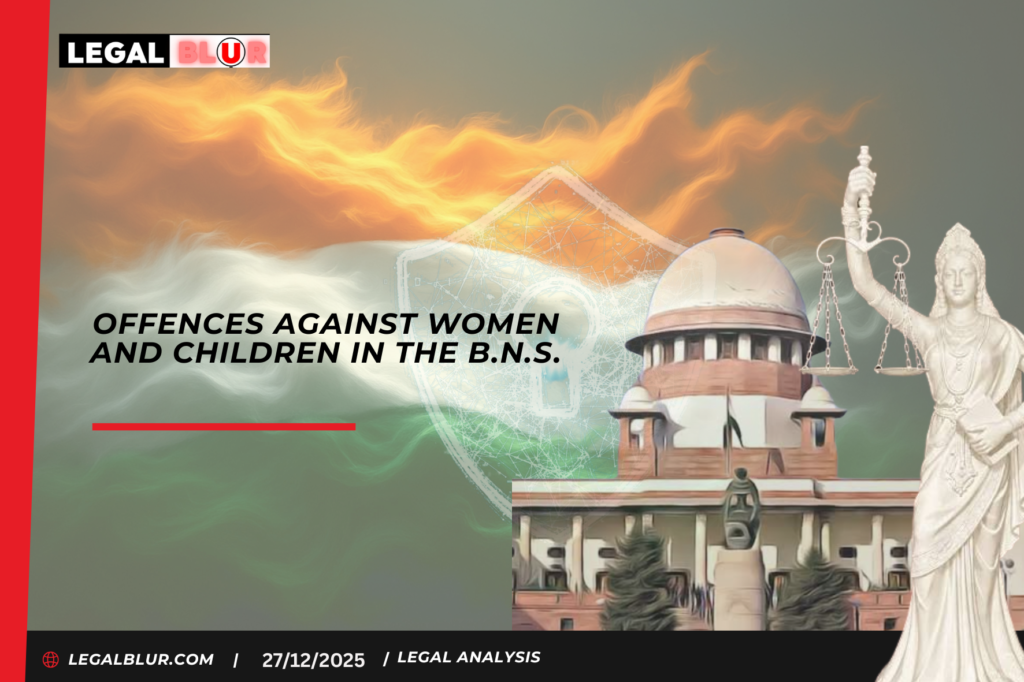
Chapter V of Bharatiya Nyaya Sanhita, 2023 (BNS) consists of offences against the child and
woman. Section 63 to 99 of BNS contains provisions with respect to offences against child which align
provisions related to abandonment and concealment of children along with offences related to
their exploitation.
Crimes And Penalties Against Women And Children In The Bharatiya Nyaya Sanhita
According to Article 14 of the constitution of India, there is equality before law but women are
faced a lot of problems from the fetus to their deathbed. Article 15 (3) allowed the state for
making special provisions for women and children. Offences against women like rape,
kidnapping, homicide for dowry, molestation, sexual harassment, dowry death. They include:
Rape
Rape is a much broader term to be defined and its scope is of wider perspective. It is the most
common crime against women and the Indian society and system has failed to end this heinous
crime. The world is seeing India as a nation of rapists. The numbers have increased
tremendously. The law system has failed purely. The offence can be categorized in various
aspects as a rape of a minor girl, rape of a woman (Section 63), rape with murder, rape in
families, rape by public servants (Section 68), Gang-rape (Section 70). The Punishments for
these offences range from imprisonment from 7 years to 20 years or Life Imprisonment and also
fine.
Kidnapping
The term kidnapping refers to either kidnapping from India or kidnapping from lawful
guardianship. Section 137 of the BNS states that whoever conveys any person beyond India
without his consent is said to kidnap that person from India and whoever takes away a minor
(16yrs in case of male and 18 years in case of female) without his consent or the guardian’s
consent is said to kidnap that person from lawful guardianship. The punishment for this purpose
is up to 7 years and fine. Section 366 of IPC defines kidnapping, abducting or inducing woman
to compel her marriage and forceful sexual relations for which the offender can be punished with
imprisonment up to 10 years and fine.
Dowry
The dowry system in India refers to the durable goods, cash, and real or movable property that
the bride’s family gives to the groom, his parents and his relatives as a condition of the marriage.
The Dowry Prohibition Act 1961 defines dowry: “Dowry means any property or valuable
security given or agreed to be given either directly or indirectly –
a) by one party in marriage to the other party in marriage; or b) by the parents of either party
to a marriage or by any other person to either party to marriage or to any other persons; at
or before or after the marriage as consideration
Sexual Harassment
Sexual harassment is a form of misconduct that involves unwelcome and inappropriate behavior
of a sexual nature. It can occur in various settings, including the workplace, educational
institutions, public spaces, or online platforms. It encompasses a wide range of actions, from
physical contact to verbal abuse or visual displays, and often leads to feelings of discomfort,
intimidation, or humiliation for the victim.
Impact of Sexual Harassment:
Sexual harassment can have significant emotional, psychological, and physical effects on
victims, including:
- Anxiety, depression, and stress
- Decreased work or academic performance
- Post-traumatic stress disorder (PTSD)
- Physical symptoms such as headaches or sleep disturbances
- Feelings of shame, guilt, or isolation
India has consistently reported more than 400 sexual harassment at work cases every year
from 2018 to 2022, according to a Business Standard report, which cited data from the
National Crime Records Bureau (NCRB).
Domestic Violence Physical, emotional, or psychological abuse within a domestic
setting, often by an intimate partner. According to the latest report by The National
Family Health Survey (NFHS) a large scale, and multi round survey conducted in Indian
households: “29.3% married Indian women between the ages of 18-49 years have faced
domestic violence/or sexual violence. 3.1% of pregnant women between the ages of 18-
49 have experienced physical violence during any pregnancy.” And that’s just the
number of cases reported by women; there are always a large number of cases that never
make it to the police.
Women Centric Changes In Procedural Law
Section 176(1) Second Proviso – In order to provide more protection to the victim and
enforce transparency in investigation related to an offence of rape, the statement of the
victim shall be recorded through audio video means by police.
Section 183(6 )(a) Proviso 1 – For certain offences against woman, statements of the
victim are to be recorded, as far as practicable, by a woman Magistrate and in her absence
a male Magistrate in the presence of a woman.
Section 183(6)(a) Proviso 2 – The Magistrate shall now record the statement of a witness
in case of certain offences against women that are punishable with imprisonment for ten
years or more or with imprisonment for life or with death.
Section 184(6) – Medical practitioners are mandated to send the medical report of a
victim of rape to the investigating officer within 7 days.
Section 179(1) First Proviso– Exemption from attending the police station is given to
woman, male person below 15 years, person above 60 years (earlier 65 years), mentally
or physically disabled person and a person with acute illness. Further, a second proviso to
sub– section (1) is added to allow the persons mentioned in the exemption category to
attend at the police station if he/she is willing so to do.
Section 195(1) Proviso – Provides that no male Section 195(1) Proviso – Provides that
no male person under the age of fifteen years or above the age of 60 years (65 years
earlier) or a woman or a mentally or physically disabled person or a person with acute
illness shall be required to attend at any place other than the place in which such male
person or woman resides. In cases where such a person is willing to attend the police
station, they may be allowed to do so.
Recommendations
For effective protection of women’s rights, the following changes can be included in Bharatiya
Nyaya Sanhita, 2023:
Marital rape should be criminalised to fill the gap.
Strengthen cyber-policing against online harassment.
Ensure cases of crimes against women are resolved within one year.
Increment in the representation of female police and judges in law enforcement.
Governments and NGOs should organise awareness campaigns to educate women about
their legal rights.
Case Laws
The Delhi gang rape case, known as Mukesh & Anr v. State (NCT of Delhi) & Ors (2017),
involved the brutal assault of a 23-year-old woman, Nirbhaya, who was raped and severely
injured by six men on December 16, 2012. After being forcibly boarded onto a vacant bus,
Nirbhaya and her friend were violently attacked, with the assailants using an iron rod, leading to
Nirbhaya’s crime scene, evidence including DNA and blood traces confirmed their involvement.
The Supreme Court deemed this case as “the rarest of rare” and sentenced the adult offenders to
death, reflecting the gravity of the crime. The minor, however, was sent to a juvenile home for
three years, as the legal provisions at the time did not permit a death penalty for those under 18.
In another case of, Pawan Kumar & Ors vs. State of Haryana (9 February 1998), the appellant,
Pawan Kumar, was convicted for the dowry death of his wife, Urmil, who had returned to her
parents’ house shortly after marriage due to dowry demands. He also received four years under
Section 306 and two years under Section 498A, with fines and default penalties, all to run
concurrently.
Conclusion
The BNS is a vital move towards ensuring legal protection of women in India. Yet, the real test of its effectiveness will be through proper implementation. Dealing with issues such as low conviction rate, lack of awareness, misuse of laws, and the persistent issue of marital rape is crucial. Continued efforts towards police and judicial reform,
increased representation of women in law enforcement, and widespread awareness campaigns
are essential to realize the full potential of the BNS in safeguarding women’s rights and ensuring
justice.
Frequently Asked Questions
1: What is the objective of including specific offences against women and children in the BNS?
The BNS aims to provide stronger protection, gender-neutral clarity where needed, and stricter punishments to deter crimes against women and children.
2: Does the BNS continue offences like rape and sexual harassment from the IPC?
Yes. The BNS retains core offences such as rape, sexual assault, stalking, and outraging modesty, with updated language and enhanced punishment structures.
3: How does the BNS protect children from sexual offences?
The BNS criminalizes sexual assault, exploitation, trafficking, and abuse of children, complementing special laws like the POCSO Act for comprehensive protection.
4: Are punishments under the BNS stricter for crimes against women and children?
Yes. Many offences attract enhanced minimum sentences, life imprisonment, or even capital punishment in extreme cases.
5: Does the BNS address modern forms of abuse against women?
Yes. The BNS includes provisions addressing stalking, voyeurism, trafficking, and exploitation using technology and digital platforms.
References
https://share.google/dNUjxSV19fR8OC2Yh