This article is written by Ishika Jangir, 1st year LL.M. student at Amity University, Kolkata. The article aims to recognise sex work as a profession.
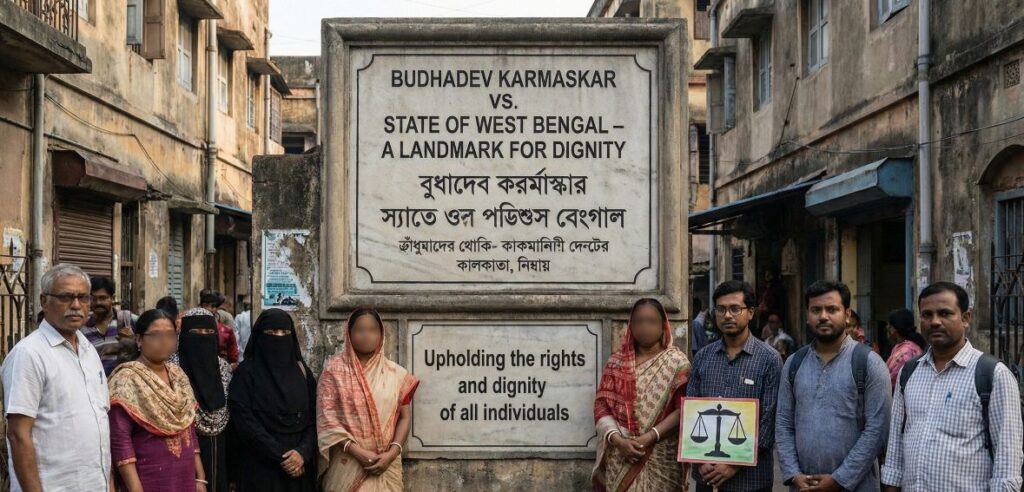
Budhadev Karmaskar v. State of West Bengal (2011) is a landmark case in Indian jurisprudence that went beyond a criminal appeal to become a major catalyst for acknowledging the human dignity and fundamental rights of sex workers in India. The Supreme Court took suo motu (on its own motion) notice of the wider predicament of sex workers after initially focussing on a brutal murder. As a result, it issued extensive directives under the broad scope of Article 21 of the Indian Constitution.
The Genesis of the Case: A Criminal Appeal
A homicide which led to a conviction of the perpetrator (Budhadev Karmaskar) for murdering Chayay Rani Pal (“Buri”) was the basis for this case. Karmaskar was accused of murdering the woman after she had declined to engage in sexual activities with him.
Following his conviction by both trial and appellate courts, Karmaskar appealed his conviction to the Supreme Court via Criminal Appeal No 135 of 2010. The Supreme Court upheld Karmaskar’s conviction for murder, but rather than focusing on punishing Karmaskar for his crime, the Supreme Court chose instead to focus on removing the obstacles that both society and the justice system have placed on women who engage in prostitution.
Judicial Leap: Suo Motu Cognizance and Article 21
The Supreme Court’s transformation of a criminal case into a public interest litigation (PIL) on the broader constitutional and humanitarian issues concerning sex workers has been a landmark event in the Supreme Court’s history. It also provided an avenue for expanding the scope of Article 21, which guarantees both the right to life and personal liberty, and will continue to act as a vehicle for judicial activism.
Interpreting the Right to Dignity
All workers, regardless of occupation or profession, are equally deserving of their human rights and dignity as human beings. The aforementioned ruling by the Court also determined that all Indian Citizens have the same fundamental right to live with dignity and to lead a life that allows them to achieve their fullest potential as human beings. Article 21 of the Constitution establishes the right to live an existence characterized by human dignity; therefore, the violence, discrimination, social stigma and other violations experienced by sex workers violate this constitutional guarantee to their human dignity.
The Court observed that:
“The approach of the enforcement authorities, especially the police, has often been brutal and violent. It is as if they are a class whose rights are not recognized. The police and other law enforcement agencies should be sensitized to the rights of sex workers who also enjoy all basic human rights and other rights guaranteed in the Constitution to all citizens.”
Directives and Recommendations: Securing Rights
In its 2011 order, the Supreme Court constituted a Panel/Committee to make recommendations for the protection and rehabilitation of sex workers. The terms of reference for this panel were crucial and focused on three primary areas:
- Prevention of Trafficking: Measures to effectively combat human trafficking and prevent individuals from being forced into sex work.
- Rehabilitation: Schemes and programs for the effective rehabilitation of sex workers who wish to leave the profession.
- Conditions for Dignity: Creating conditions conducive for sex workers who wish to continue working to live with dignity in accordance with Article 21.
Key Directions from Subsequent Orders (Up to 2022)
Throughout the years, the Supreme Court has monitored the implementation of the Recommendations by the Committee, and has issued a number of Very Important Directives, culminating in the 2022 landmark decision in which the Court used its extraordinary powers under Article 142 to implement the recommendations as a result of the Inaction by the Legislative body.
The most notable directions include:
- Acknowledgement of Sex Work as a Profession: The Court declared that sex workers are entitled to equal protection under the law and specifically acknowledged sex work as a profession.
- Non-Interference by Police: When an adult sex worker participates voluntarily, police are not allowed to interfere or prosecute them. Only when there is proof of forced sex labour, trafficking, or the involvement of minors should an arrest be made.
- Protection against Police Abuse: In order to guarantee that sex workers are treated with dignity and are not subjected to violence, verbal or physical abuse, or coercion into engaging in any sexual activity, the Court ordered police and law enforcement agencies to raise their level of awareness.
- Victim Status for Sexual Assault: When a sex worker is sexually assaulted, they must be treated as victims and the perpetrator must face legal consequences. They shouldn’t be subjected to discrimination by the police because of their occupation.
- Children of Sex Workers: Because of the mother’s occupation, no child of a sex worker should be kept apart from her. There must be no discrimination against them in educational institutions.
- Identity and Social Security: In order to ensure that sex workers have access to social security programs and basic amenities, directives were given to the UIDAI (Unique Identification Authority of India) to issue Aadhar cards to them without requiring proof of residency if certified by a Gazetted Officer at the State Health Department or NACO (National AIDS Control Organisation).
Legal and Social Impact
The Budhadev Karmaskar judgment marks a significant shift from viewing sex workers primarily as criminals or immoral figures to recognizing them as citizens with constitutional rights, often forced into the profession by poverty and circumstances.
Clash with Existing Law
By recognizing sex work as an actual profession and prohibiting law enforcement from interfering with consensual adult sex work, the judgment has addressed a possible conflict with certain elements of the Immoral Traffic (Prevention) Act, 1956 (ITPA). This legislation targets those individuals or groups engaging in organized prostitution, keeping brothels, and trafficking; thus, certain sections within ITPA, such as Section 8 (soliciting) and Section 4 (living upon the proceeds of prostitution), serve to harass adult sex workers. The directives from the Supreme Court provide a constitutional basis to protect sex workers and expand the definition of fundamental rights in order to relieve the excessive impact of existing laws on those individuals until the Parliament creates new and comprehensive legislation on this matter.
Conclusion
The ruling issued in Budhadev Karmaskar’s case is more than a simple criminal conviction. It represents a clear affirmation of an individual’s human rights and constitutes an invitation to reform our social and legal institutions. The Supreme Court rejected the argument that the occupation of an individual, regardless of how much stigma is associated with that occupation, shall preclude an individual’s access to his or her fundamental right to live with dignity. This ruling extends the reach of Article 21 to a greater degree than has previously been done, and brings the Indian people one step closer to honouring their constitutional commitment to provide justice, equality, and dignity to all persons. The directives issued by the Courts now constitute the prevailing standard for providing protection from discrimination and exclusion of individuals from the most vulnerable segments of society by state officials and police, until the ultimate resolution of legislative reform is achieved.
FAQs
1. What was the Budhadev Karmaskar case originally about?
The case began as a Criminal Appeal (No. 135 of 2010) against Budhadev Karmaskar’s conviction for the heinous killing of a prostitute. The Supreme Court turned the appeal into a case involving sex workers’ constitutional rights while upholding the conviction after taking suo motu (on its own motion) notice of the larger, systemic problems they face.
2. What is the most significant legal outcome of this case?
The Supreme Court’s unambiguous affirmation that sex workers are entitled to a life of dignity and are guaranteed all fundamental rights, particularly the Right to Life and Personal Liberty under Article 21 of the Constitution, is the most important legal outcome. Later on, the Court formally acknowledged sex work as a profession.
3. Did the Supreme Court legalize sex work in India?
A law legalising sex work was not passed by the Supreme Court. Nonetheless, the Court used its extraordinary authority under Article 142 in its 2022 ruling to mandate that police refrain from interfering with or prosecuting an adult sex worker engaged in consensual sex work. By recognising consensual adult sex work as a matter of dignity and personal choice, this direction offers a constitutional shield.
References
- Recognition of Sex Work as a Profession (Recognition of Sex Work as a Profession)
- Kunal Singh, IP & LEGAL FILINGS (Nearly Three Years After the Supreme Court’s Landmark Judgment, Sex Workers in India Still Wait for Change)
- Kavita Chowdhury, The Diplomat (India’s Supreme Court Recognizes Sex Work as a Profession – The Diplomat)