Authored by Divya S. Sohoni
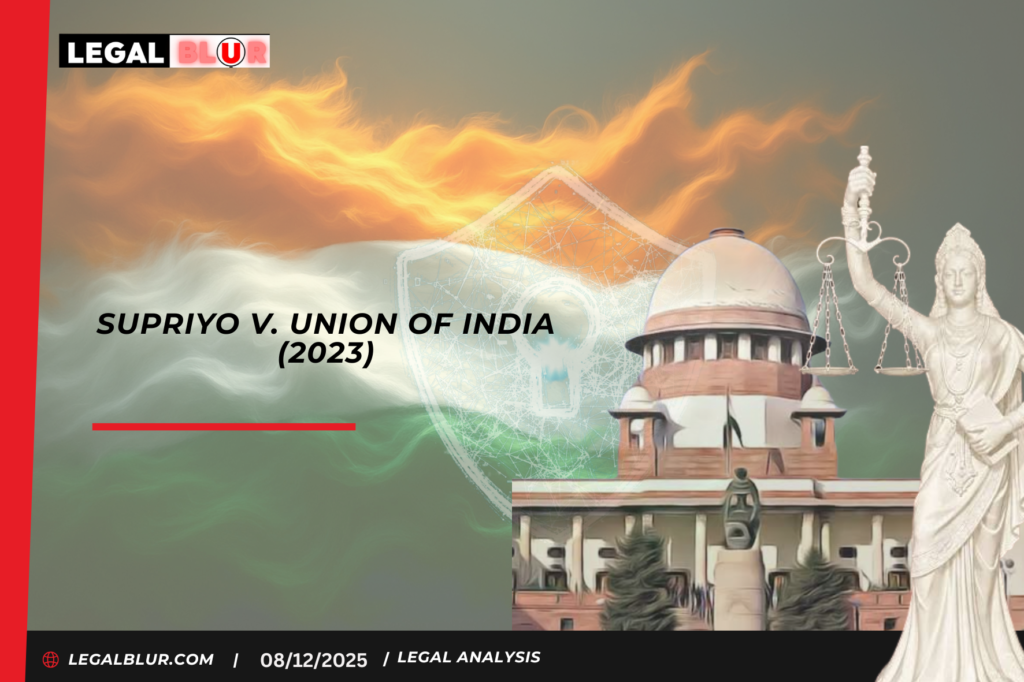
The issue of marriage equality in India: A critique of the Supreme Court’s
ruling in Supriyo v. Union of India (2023)
The question of marriage equality takes up a significant place in current constitutional
discussions. India’s hardy LGBTQ+ populace has struggled for decades to establish legal
recognition, dignity, and equal rights. Whereas the legal battle for civil war in India’s climate.
While the Navtej Singh Johar v. Union of India (2018) judgment decriminalized consensual
same-sex relations, the fight for same-sex marriage found itself stalled in legal purgatory.
This issue was then directly before a Constitution Bench in Supriyo @ Supriya Chakraborty
& Ors.
The case was of great legal, social and constitutional significance. Petitioners contended that
the exclusion of the right to get married is a violation of Articles 14, 15, 19 and 21 of the
Indian Constitution. On the other hand, the UGC argued that marriage was a matter
of legislation and not of judiciary and “”civil unions”” could be considered in place of
marriage.
In this article, it will be discussed the historical context, major arguments, reasoning of the
SC and the implications of this ruling. The Court’s denial of same-sex marriage in not a
surprise, but the ruling is an important day in the development of constitutional rights in
India.
Case Laws (Detailed Analysis)
- Supriyo @ Supriya Chakraborty & Ors. v. Union of India (2023)
Supreme Court- 5 Judges Constitution bench
This matter is at the heart of the debate. A cluster of same-sex couples and LGBTQ + rights
advocates petitioned the Supreme Court for recognition of their right to marry under the
Special Marriage Act, contending that the Act requires to be interpreted in a gender-neutral
way.
Key Issues Raised:
- Is marriage a fundamental right under Articles 19 and 21.
- Does the exclusion of same-sex couples from the institution of marriage
constitute a violation of equality under Article 14. - Whether the Special Marriage Act is capable of a gender-neutral
interpretation. - Do LGBTQ+ couples have the right to adopt jointly.
Majority Opinion:
(but Chief Justice Chandrachud partially dissenting) the majority (Justice Bhat, Kohli,
Narasimha agrees) held:
- Marriage is a statutory right, not a fundamental right.
- Same-sex marriages cannot be “judicially reframed” under the Special
Marriage Act. - The Court cannot legislate for a new legal regime for marriage; this is the
province of the Parliament to legislate. - The CARA (Central Adoption Resource Authority) norms which disallow
unmarried couples from adopting were upheld.
The majority recognized discrimination and hardships faced by LGBTQ+ people, but that
legal sanctioning of marriage would require legislative consideration and
democratic process.
Minority Opinion by CJI D.Y. Chandrachud (BW Partly Dissenting):
The Chief Justice gave a separate verdict, holding: - Every individual has a fundamental right to form “intimate associations” under
Articles 19 and 21. - LGBTQ+ couples have the right to enter into a civil union.
- Denying joint adoption rights is unconstitutional as it is not based on empirical
evidence. - State cannot deny legal entitlements merely on the basis of sexual orientation.
However, even the CJI stopped short of fully legalizing same-sex marriage.
Significance:
Despite not granting marriage equality, this case:
- Recognized discrimination against LGBTQ+ couples as a constitutional
concern. - Affirmed dignity and autonomy as essential rights.
- Reinforced the need for legislative reform.
- Encouraged future recognition through civil unions.
The case remains a crucial precedent shaping India’s evolving equality jurisprudence.
- Navtej Singh Johar v. Union of India (2018) – Background Precedent
Supreme Court- 5 Judges Constitution bench
It is a very core issue in this debate. some same-sex couples and advocates for LGBTQ +
rights had asked the Supreme Court to recognize their right to marry under the Special
Marriage Act, arguing that the Act needs to be read in a gender-neutral manner.
Key Issues Raised:
- Is marriage a fundamental right under Articles 19 and 21.
- Is the bar on same-sex marriage an equal protection violation under Article 14.
Is the Special Marriage Act amenable to a gender-neutral construction?
Are lgbtq+ couples entitled to joint adoption.
Majority Opinion:
(but Chief Justice Chandrachud partially dissenting) the majority (Justice Bhat,
Kohli, Narasimha agree) held:
- Marriage is a statutory right not a fundamental right:
- Same-sex marriages cannot be “judicially reframed” under the Special
Marriage Act. - The Court cannot legislate for a fresh structural paradigm for marriage; that is
the duty of the Parliament to legislate. - The CARA (Central Adoption Resource Authority) guidelines that prohibit
unmarried couples from adopting were upheld. The majority acknowledged discrimination
and the challenges that LGBTQ+ people confront, but that legal authorization of marriage
would necessitate legislative thought and the democratic process.
Minority Opinion by CJI D.Y. Chandrachud (BW Partly Dissenting):
The Chief Justice gave separate verdict, holding:
- K.S. Puttaswamy v. Union of India (2017) – Privacy and Autonomy
Since it is Puttaswamy, though it was filed before 2022, is it critical. It declared privacy a
fundamental right and held that decisions personal to marriage, relationships and sexual
intimacy are within the zone of privacy-protected autonomy.
In Supriyo, the Supreme Court referred to Puttaswamy to hold as under:
- The State cannot intrude upon intimate life, without constitutionally
permissible justification. - People are entitled to privacy in choosing life partners.
The petitioners contended that privacy and dignity should apply to marital choice as well for
the same-sex unions. However, “choosing a partner” and “statutory recognition of
marriage are veritably distinct.”
- Shafin Jahan v. Asokan (2018) – Choice of Partner is a Fundamental Right
In this context it was held that the right to choose a partner is an essential part of the personal
liberty and this is protected under Article 21.
The petitioners in Supriyo relied on this precedent to contend that if the right to choose a
partner is a fundamental right, the same would necessitate legal recognition of such
partnerships. The Court recognized that partner choice is a protected interest, but cautioned
that “choice” alone does not give rise to a statutory right to marry.
Sandhya Jain and Parthasarathy Sadashivam v. Union of India (2022) – The Notion of Family
has been forever changed in the Eye of the Law.
In a landmark judgment of 2022, it was held by the Supreme Court that family can assume
various forms and law needs to recognize “familial relationships” outside the confines of the
traditional family.
The case was especially significant in Supriyo where respondents highlighted that LGBTQ+
families do exist and deserve legal protection. Justice Chandrachud, in his dissent, also placed
considerable reliance on Deepika Singh to make a case for recognition of and the
rights emanating from civil unions.
Conclusion
The decision in Supriyo v. Union of India (2023) is a watershed moment in India’s
constitutional history on LGBTQ+ rights. Also, while the Court did not hold that the
Constitution guarantees marriage equality, the opinion extolled basic principles of dignity,
equality, and non‒discrimination. The Court recognized the difficulties and challenges that
gay couples face and stressed that the legislature must give meaningful consideration to a
legal regime that would permit the recognition of same-sex unions.
This judgment’s significance cannot be diminished simply because it did not extend marriage
equality. It has set in motion constitutional pressures and blueprints for further LGBTQ+
recognition. The Court’s forward-looking pronouncements, particularly in the dissent,
provide the platform for future legal battles. Marriage equality in India might not be an
available concept yet, but the discussion is now definitely part of the constitutional discourse.
The road to full equality still lies ahead – marked, informed, empowered, and shaped by
decisions such as Supriyo.
FAQs
- Does the Supreme Court’s 2023 judgment legalize same-sex marriage?
No. The Court refused to legalize same-sex marriage and stated that changes to marriage laws
must be done by Parliament, not the judiciary.
- Do LGBTQ+ couples have the right to form civil unions?
Justice Chandrachud held they do, but the majority did not expressly recognize civil unions.
The issue remains open for future legislation.
- Can same-sex couples adopt children after this judgment?
No. The majority upheld CARA’s rule restricting joint adoption to heterosexual married
couples.
- What rights do LGBTQ+ couples currently have?
They have the right to cohabit, form relationships, and live together without State
interference. But statutory rights linked to marriage are still not available.
- Why is Supriyo considered a landmark case?
Because it brings marriage equality into mainstream constitutional debate, acknowledges
discrimination, and calls upon the legislature to act.
References