This article is written by Nidhi Singh, student at Fairfield Institute of Management and Technology affiliated with Guru Gobind Singh Indraprastha University.
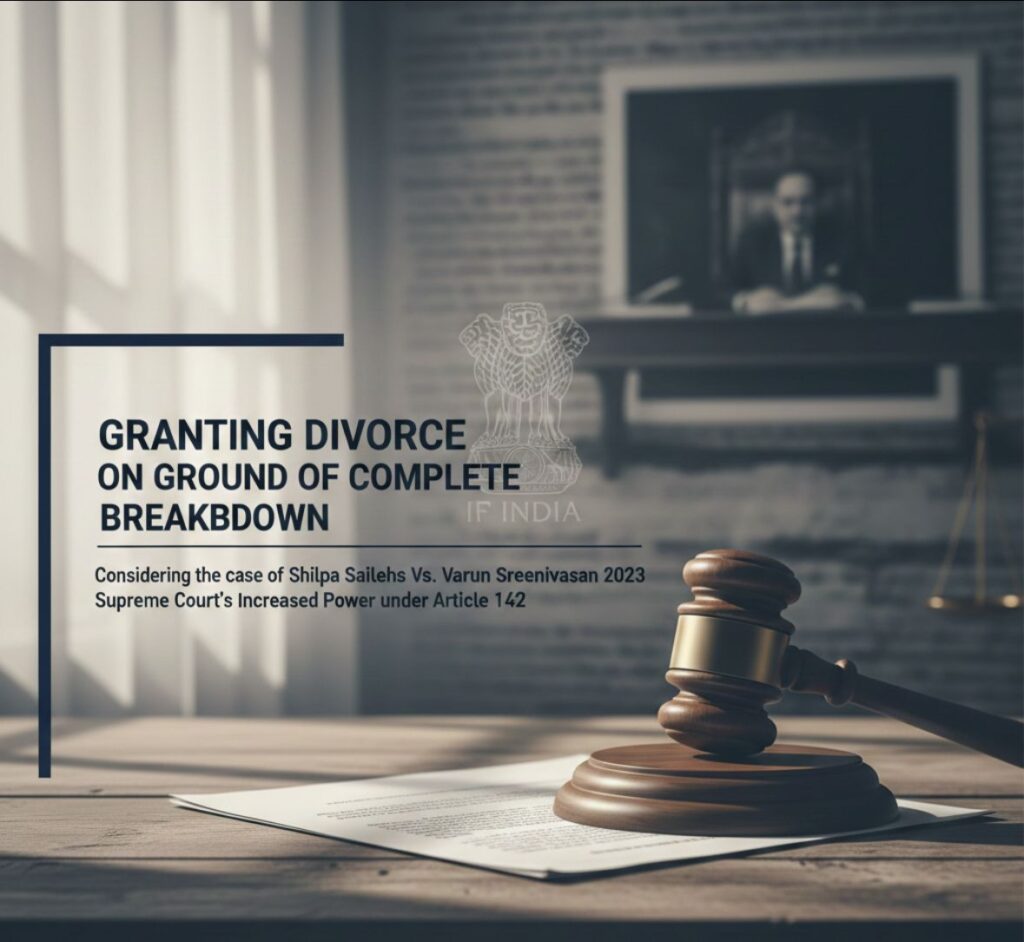
Divorce law in India has had a statutory basis since the emergence of the Hindu Marriage Act, 1955 (HMA), Special Marriage Act, 1954 (SMA), personal laws, and so on. Under the said statutory schemes, for people to obtain a divorce under the mutual consent basis, they must follow strict procedural requirements, including mandatory six-month “cool with period” under section 13B (2) of HMA. Litigants trapped in long, irretrievably broken marriages often suffered from the hard statutory limitations and stultifying litigation.
The Supreme Court’s Constitution Bench judgment in the case Shilpa Sailesh Vs. Varun Sreenivasan is a jurisprudential game Changing. The Court held that it can grant divorce on the ground of irretrievable breakdown of marriage under its plenary powers of Article 142 though one spouse does not agree and where statutory provisions do not admit such divorce.
This ruling gives the courts much more discretion, it harmonizes family law with constitutional values, and it offers relief to those involved in a long emotional and legal conflict. It also explains the contours of Article 142 – a provision to allow the Supreme Court to do “complete justice” between parties.
Case Laws
Background and Facts
The dispute was over a petition filed under Article 142 of seeking dissolution of marriage between the petitioner-wife, Shilpa Sailesh, and the respondent-husband, Varun Sreenivasan. The parties were involved in several litigations for years including litigations pertaining to divorce, custody, maintenance as well as criminal allegations.
The Supreme Court directed the issue to a Constitution Bench for adjudication on an important legal issue:
Key Question:
Can the Supreme Court give divorce invoking Article 142 on the ground of irretrievable breakdown of marriage even if statutory requirements or the refusal of one partner stand in the way?
This question had caused inconsistencies in past judgments. Some of the benches favoured divorce in Article 142 and some declined it, saying that this power would amount to rewriting of statutes.
The Constitution Bench took the long journey to delve in-depth into precedent in an effort to put the matter to rest once and for all.
The Supreme Court’s Holding (2023)
The Constitution Bench of the Supreme Court (Justice headed by S.K. Kaul, Sanjiv Khanna, A.S. Oka, Vikram Nath and J.K. Maheshwari) ruled:
1. Supreme Court can grant divorce on irretrievable break-up of marriage under Article 142
Even where there are no statutory grounds for doing so, or when one of the parties (the spouse) resists the divorce, the Court can dissolve the marriage if it believes that the relationship has totally broken down.
2. The six months cooling off period provided under Section 13B (2) is not mandatory
The Court may waive the period where:
- parties have been separated by a long time
- every attempt of reconciliation has failed
- continuation of marriage would occasion injustice
- issues such as custody, alimony, properties division is settled or the Court can settle it
3. Family courts and statutory provisions cannot restrain article 142 powers
The judgment emphasizes the fact that Article 142 is a constitutional power, which is not bound by procedural restrictions of statutes.
4. Relief needs to be exercised with caution
The Court set out a set of factors to use this extraordinary power with caution:
- length of separation
- nature of allegations
- attempts at mediation
- existence of parallel litigations
- welfare of children
- financial arrangements
- equity of justice to both parties
Doctrinal Significance of the Judgment
A. Reinforcement of Article 142 Plenary Nature
Article 142 gives powers to the Supreme Court to grant any order that is necessary to do “complete justice.”
The judgment supports this principle:
- It is not restricted by the provisions of statutes
- It may devise special remedies in cases where statutes leave voids
- It may override rigorous procedures in matters pertaining to the marriage procedure
Thus, Article 142 emerges as a brick wall right between stony family laws and the social justice needs of the times.
B. Recognizing Irretrievable Breakdown of Marriage as independent Basis of Divorce
While statutory law in India does not recognise “irretrievable breakdown” as a formal ground of divorce (although there have been Law Commission recommendations to this effect), it is now considered to be a constitutional ground under Article 142 by the Supreme Court.
This development:
- brings Indian law within the international matrimonial jurisprudence
- mitigates years of torture in the case of dead marriages for their spouses
- encourages faith in judicial efficiency and fairness
C. Harmonising the Statutory Law with Constitutional Values
The Court emphasised that marriage was a social institution but had to also fit with:
- human dignity
- personal liberty
- mental well-being
- gender equality
Continuing in a marriage that turned into a source of trauma is violative of the constitutional vow of dignity of Art 21.
D. Impact on Principle of Consent in Mutual Divorce
Whereas, mutual consent traditionally means voluntary agreement by both parties, the Court explained:
- Lack of consent cannot be used to mentally imprison a spouse in a dead marriage.
Thus, consent under Section 13B is no longer an absolute bar to dissolution provided integrity to both sides is guaranteed by the Court.
Key Precedents Examined
Following are some of the landmark cases analysed and harmonised by the Constitution Bench:
1. Naveen Kohli v. Neelu Kohli (2006)
This case is the foundation for the doctrine of “irretrievable breakdown of marriage.” The Supreme Court noted that the marriage was emotionally dead, after years of antagonism and lawsuits. The Court recommended to Parliament for making the ground of irretrievable breakdown as an independent ground for divorce in Hindu Marriage Act. Although no amendment was made to the statute concerning it, this judgment played a major role in later precedents.
2. Samar Ghosh v. Jaya Ghosh (2007)
The Court formulated general guidelines for determining “mental cruelty.” It held prolonged separation and emotional imbalance of intimacy and constant litigation may themselves constitute as mental cruelty. These sorts of indicators are often used in investigating whether a marriage is broken down beyond repair.
3. R. Srinivas Kumar v. R. Shametha (2019)
Supreme Court under article 142 exercised powers to dissolve a marriage, despite lack of mutual consent, on the grounds that the continued separation of a couple for decades showed that it was an irretrievable breakdown.
Practical Implications
1. Reliefs for spouses trapped in broken marriages
The courts have provided individuals with a constitutional remedy for those who are facing prolonged litigation.
2. Fostering of equitable settlements
The insistence of the Court of balancing equities incentivises amicable resolution of:
- Alimony
- Custody
- visitation rights
- property matters
3. Clear direction found for future benches
Lower courts have to follow the statutory provisions, still the Supreme Court has the exceptional power.
4. Curbing misuse
The guidelines given by the Court are cautionary in nature and to avoid misuse from the litigants seeking for quick divorces without fulfilling responsibilities.
Conclusion
The Supreme Court’s order in the case of Shilpa Sailesh Vs. Varun Sreenivasan (2023) is a giant step in Indian matrimonial jurisprudence. By recognising irretrievable breakdown of marriage as a constitutional basis for divorce under Article 142, the Court guarantees individual dignity and ensures substantive justice and bridges a long-standing legislative vacuum.
The ruling enhances the transformative power of the Supreme Court and gets wedlocked marriages that are suffering from hopelessness and cruelty in the marriage to not be artificially kept alive due to collateral rules of procedure. It is a progressive move which harmonizes social values with constitutional morality.
FAQs
Q1: Can lower courts grant Divorce in case of irretrievable breakdown of Marriage?
A: No. Such divorce can be granted by no other court other than Supreme Court as per Article 142. Lower courts are bound by the provisions of the statute unless an amendment is made by the Parliament.
Q2: Is it necessary for consent of both spouses in order to get divorced after this judgment?
A: Not necessarily. If the Supreme Court is convinced that the marriage is dead and there is no possibility of reconciliation, the court has the right to dissolve the marriage without the consent of both the couples.
Q3: Now the six-month waiting period is abolished?
A: It is not abolished but it can be waived by the Supreme Court. Lower courts are entitled to waive it only in limited circumstances as held in Amardeep Singh v. Harveen Kaur (2017).
Q4: What is the evidence that the Court sees for irretrievable breakdown?
A: It takes into account long separation, failed mediation, bitterness, multiplicity of litigations, welfare of children and other ascertainment of impossibility of cohabitation in general.
Q5: Does this judgment apply to all religions?
A: Yes. As Article 142 is a constitutional power it makes personal laws ineffective.
References (Links)
- Shilpa Sailesh v. Varun Sreenivasan (2023) 14 SCC 231
https://api.sci.gov.in/supremecourt/2014/26304/26304_2014_2_1501_44203_Judgement_01-May-2023.pdf
- Naveen Kohli v. Neelu Kohli, (2006) 4 SCC 558
https://indiankanoon.org/doc/1643829
- Samar Ghosh v. Jaya Ghosh (2007) 4 SCC 511
https://api.sci.gov.in/jonew/judis/28780.pdf
- R. Srinivas Kumar v. R. Shametha (2019) 9 SCC 409
https://indiankanoon.org/doc/37507130
- Constitution of India – Article 142
- Hindu Marriage Act, 1955 – Section 13-B – Divorce by mutual consent
https://www.indiacode.nic.in/show-data?actid=AC_CEN_3_20_00004_195525_1517807318992&orderno=15