This article is written by Samriddha Ray, St. Xavier’s University, Kolkata
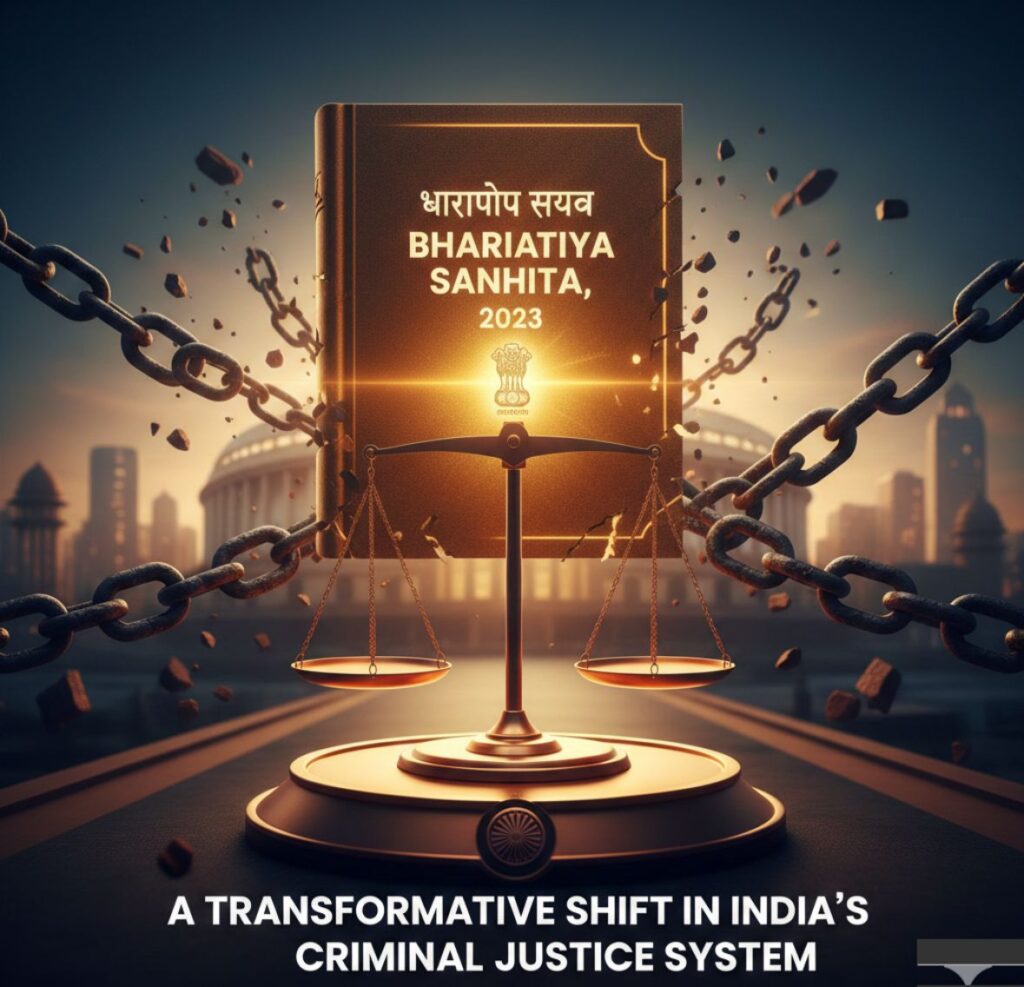
The Bharatiya Nyaya Sanhita, 2023: A Transformative Shift in India’s Criminal Justice System
The year 2023 marked one of the most significant turning points in India’s criminal justice landscape with the enactment of the Bharatiya Nyaya Sanhita (BNS), 2023, replacing the 163-year-old Indian Penal Code (IPC). The new legislation seeks to modernize criminal law in alignment with constitutional values, societal needs, and technological realities. The Act aims to decolonize India’s criminal justice system by removing archaic terminology, introducing new offences such as mob lynching and organized crime, strengthening provisions on sexual offences, and integrating technology-driven processes.
This article examines the key features of the BNS, supported by relevant case laws, and evaluates whether the statute meaningfully advances criminal justice or merely re-packages old principles under new terminology.
Key Judicial Principles Impacted by the BNS
Although the BNS is newly enacted, its provisions must be interpreted in light of long-standing Supreme Court jurisprudence. The following case laws are crucial to understanding how constitutional courts may interpret major sections of the BNS.
1. Kedar Nath Singh v. State of Bihar (1962)
One of the most significant changes under the BNS is the repeal of the colonial sedition provision under Section 124A IPC. While the Government claims sedition has been removed, critics argue that Section 150 of the BNS, dealing with “acts endangering sovereignty, unity and integrity of India,” essentially revives sedition under new terminology.
In Kedar Nath Singh, the Supreme Court held that criticism of the government cannot be criminal unless accompanied by incitement to violence or public disorder. This constitutional standard remains relevant to interpreting Section 150 of the BNS, as any broad or vague application would violate Articles 19(1)(a) and 19(2).
The judgment underscores that restrictions on free speech must be narrowly tailored — a principle the judiciary is expected to enforce under the new law.
2. Shreya Singhal v. Union of India (2015)
In Shreya Singhal, the Supreme Court struck down Section 66A of the IT Act for vagueness, overbreadth, and chilling effect. This jurisprudence is relevant because the BNS introduces new offences relating to:
- Digital records
- Electronic documents
- Cyber fraud
- Identity theft
Any broadly worded digital offence under the BNS may face constitutional scrutiny under the Shreya Singhal standard. The Court has made it clear that criminal statutes must not be vague or open-ended.
Thus, challenges are likely if BNS provisions criminalize online expression or digital acts without precise definitions.
3. Lalita Kumari v. Government of Uttar Pradesh (2013)
The BNS alters the criminal procedure landscape by emphasizing the filing of FIRs through digital platforms and imposing stricter time limits on investigation.
In Lalita Kumari, the Supreme Court mandated that police must register an FIR in all cases where a cognizable offence is disclosed. The BNS strengthens this principle by formalizing digital FIR filing and time-bound investigation mandates.
However, critics fear that increased police discretion under certain BNS provisions may dilute the Lalita Kumari safeguards, potentially enabling arbitrary or selective registration of cases.
4. Navtej Singh Johar v. Union of India (2018)
While the BNS has removed the archaic provision criminalizing homosexuality (reflecting Navtej Singh Johar), concerns persist regarding moral policing, obscenity provisions, and broad definitions of public decency.
The judgment emphasizes that criminal laws must uphold constitutional morality rather than majoritarian morality. Under this principle, any BNS provision restricting bodily autonomy, sexual orientation, or privacy will be measured against the standards of dignity and individual liberty established in Navtej Singh Johar.
5. Vishaka v. State of Rajasthan (1997)
The BNS significantly expands offences relating to sexual harassment, assault, exploitation, and violence. The Supreme Court’s decision in Vishaka laid the foundation for gender-sensitive interpretation of criminal law.
The inclusion of gender-neutral language for certain offences under the BNS is a step forward, but debates continue regarding whether the statute sufficiently protects transgender persons and gender minorities. Judicial interpretation is likely to rely on Vishaka principles of dignity, equality, and workplace safety.
Additional Key Features of the BNS with Legal Implications
A. Introduction of Mob Lynching Provisions
The BNS explicitly criminalizes mob lynching, a long-demanded reform. Although the Supreme Court in Tehseen Poonawalla v. Union of India (2018) called for a special law to combat lynching, Parliament incorporated these offences within the BNS.
This reflects judicial recognition that collective violence requires a distinct penal response.
B. Enhanced Penalties for Crimes Against Women and Children
Following years of Supreme Court jurisprudence emphasizing speedy trials and victim protection (e.g., Nipun Saxena v. Union of India), the BNS introduces:
- Mandatory forensic collection in rape cases
- Stricter punishments
- Time-bound investigations
These changes align with judicial directives and modern evidentiary practices.
C. Recognition of Organized Crime, Terrorism, and Cybercrime
Borrowing concepts from state laws like the MCOCA, the BNS consolidates serious offences under a unified legal framework. Courts will likely rely on precedents such as Kartar Singh v. State of Punjab (1994), which held that anti-terror laws must balance national security and individual liberty.
D. Increased Use of Technology
The BNS integrates:
- Electronic summons
- Digital search warrants
- Online FIR registration
- Electronic evidence admissibility
This reflects the Supreme Court’s approach in Anvar P.V. v. P.K. Basheer (2014), which recognized the evidentiary value of digital records.
Conclusion
The Bharatiya Nyaya Sanhita, 2023 represents one of the most significant reforms in India’s criminal justice system since independence. While the law aims to modernize criminal jurisprudence and eliminate colonial vestiges, concerns remain regarding the revival of sedition-like offences, increased police powers, and potential misuse of broad legal provisions.
Judicial interpretation will play a decisive role in determining whether the BNS becomes a tool for safeguarding constitutional rights or reinforcing state authority. Ultimately, the success of the BNS depends not merely on statutory language but on its implementation, judicial checks, and alignment with constitutional values of liberty, dignity, and fairness.
Frequently Asked Questions (FAQs)
1. What is the Bharatiya Nyaya Sanhita (BNS), 2023?
It is a new criminal law enacted to replace the Indian Penal Code, aiming to modernize, simplify, and decolonize criminal justice in India.
2. Does the BNS remove sedition completely?
The government claims sedition is removed, but critics argue that the new Section 150—“acts endangering sovereignty”—has similar effects to sedition and could be misused.
3. What new offences are introduced under the BNS?
New offences include mob lynching, organized crime, terrorism, cyber fraud, and identity theft.
4. How does the BNS impact sexual offence laws?
It strengthens penalties, mandates forensic procedures, and updates definitions to reflect modern understanding of consent and gender.
5. Is the BNS more citizen-friendly or police-friendly?
Opinions vary. While some reforms protect victims and promote faster trials, other provisions increase police discretion, which may lead to misuse if not properly checked.
Sources
1. The Bharatiya Nyaya Sanhita, 2023 – Official Gazette Notification (Government of India)
https://egazette.nic.in/WriteReadData/2023/248969.pdf
2. PRS Legislative Research – “Bharatiya Nyaya Sanhita, 2023: Bill Summary and Key Changes”
https://prsindia.org/billtrack/bharatiya-nyaya-sanhita-2023
3. Ministry of Home Affairs Press Release – Introduction of BNS as a Replacement for the IPC (2023)
https://pib.gov.in/PressReleasePage.aspx?PRID=1940186
4. The Hindu – “Explained: What the Bharatiya Nyaya Sanhita Seeks to Change”
A credible national newspaper that provides expert analysis of the changes, including sedition, terrorism, digital offences, and mob lynching.
https://www.thehindu.com/news/national/explained-bharatiya-nyaya-sanhita/article67289880.ece
5. LiveLaw – “Bharatiya Nyaya Sanhita: Key Highlights and Major Reforms”
Respected legal journalism source offering in-depth coverage of the BNS and debates around its implications.
https://www.livelaw.in/news-updates/bharatiya-nyaya-sanhita-2023-key-features-239829