Authored by Akash Avthale
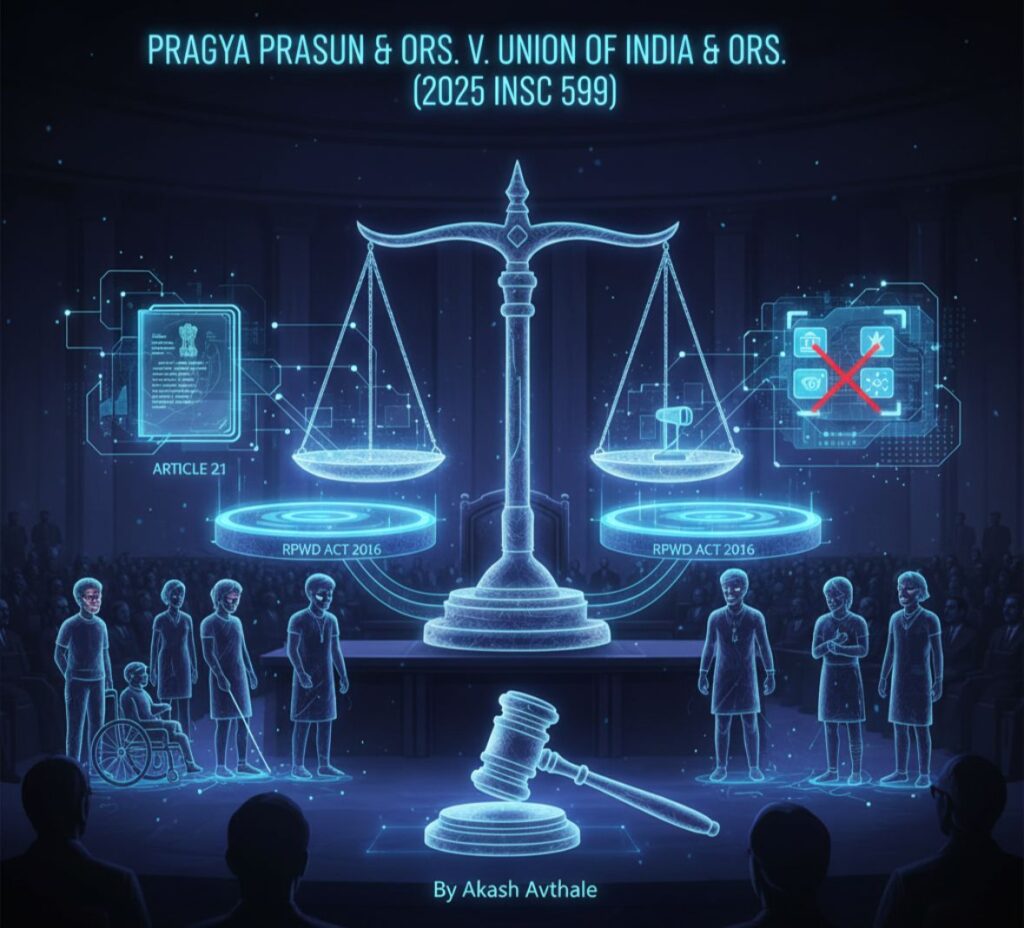
PRAGYA PRASUN & ORS. V. UNION OF INDIA & ORS. (2025 INSC 599)
FACTS
Pragya Prasun & Ors. v. Union of India & Ors. 2025 INSC 599 Two writ petitions were filed before the Supreme Court of India by the persons with disabilities in the form of acid attack survivors who suffered permanent facial and eye disfigurement and a person with 100% blindness due to their inability to access basic services because of the digital process of Know Your Customer being inaccessible.
The petitioners argued that the extant digital KYC, e-KYC, and Video-KYC processes were exclusionary and discriminatory because they were predicated on requirements like facial recognition, eye-blinking, clicking a live photograph, or signing using a touchscreen-no one of which could conceivably be done by individuals afflicted with visual impairments or facial disfigurement.
The petitioners thus sought directions to the Central Government and statutory and regulatory bodies, namely RBI, SEBI, TRAI, PFRDA, and IRDAI, to adopt inclusive digital KYC procedures. Inaccessible verification protocols, they said, were excluding them from basic services like banking, obtaining a SIM, and availing of pension, thereby denying their rights under Article 21 of the Constitution and the Rights of Persons with Disabilities Act, 2016.
ISSUES
- Whether the uniform application of digital KYC procedures, which rely on biometric and visual identifiers, violates the fundamental rights of persons with disabilities under Article 21 of the Constitution.
- Whether regulatory frameworks, such as RBI KYC Master Directions, 2016, are in compliance with the provisions of the Rights of Persons with Disabilities Act, 2016, particularly with regard to reasonable accommodation and accessibility.
- Whether the lack of alternative mechanisms for digital KYC constitutes systemic discrimination and exclusion of persons with disabilities.
- Whether the respondents have complied with national and international standards such as RPwD Rules, ICT accessibility norms, and the UN Convention on the Rights of Persons with Disabilities (UNCRPD).
Petitioners’ Contentions
The requirement of “live photograph” verification, and liveness detection based on eye-blinking or visual confirmation, is discriminatory against persons with facial disfigurement or blindness.
There is no legal definition or uniform application of the concept “liveness,” and most regulated entities interpret it restrictively.
Platforms used for e-KYC are not accessible: screen readers cannot access it, camera alignment instructions are not provided, and thumb impressions and voice confirmation are not accepted.
While theRPwD Act under its Section 40 and 46 requires accessibility and reasonable accommodation, the authorities completely missed framing inclusive aspects of the digital identity verification mechanism.
Again, the prohibition on prompting during live KYC calls further disadvantages visually impaired users who may require assistance.
Respondents’ Contentions
The KYC process is mandated under the Prevention of Money Laundering Act, 2002, and RBI’s KYC Master Directions, 2016.
Blinking is not an absolute requirement for a “live” image; the regulated entities can use voice prompts or test for facial movement.
Already, RBI, SEBI, IRDAI, among others, have allowed physical KYC and offline alternatives in exceptional cases, which include persons with disabilities.
Steps have been taken to improve accessibility through policy modifications, staff training, and user-interface audits.
The intervention of the Court is thus not required because the statutory framework is already being adapted to the needs of PwDs.
Law
The Supreme Court held that technological advancement must not deepen existing social exclusion but should facilitate inclusion. It emphasized that denial of access to essential services like banking, insurance, and telecommunications due to the design of digital KYC procedures violates the right to dignity, autonomy, and equality of persons with disabilities under Article 21 of the Constitution.
RPwD Act, 2016: Especially Sections 3 (equality and non-discrimination), 13 (financial access), 40 (accessibility standards), and 46 (implementation timelines for service providers).
Constitutional Principles: Article 21 includes the right to live with dignity, and digital exclusion from services touches upon this right.
It concluded that digital KYC procedures must adopt alternative verification methods such as voice recognition, facial gestures, or assisted verification. The “live photo” requirement must be interpreted to include non-visual and non-biometric means.
Conclusion
This case is a landmark in Indian constitutional and disability rights jurisprudence. The Supreme Court not only recognized the legal rights of persons with disabilities in the digital realm but also enforced structural reforms in how digital identity verification is conducted.
It reaffirmed the principle that accessibility is a right, not a privilege, and that digital progress must not exclude the most vulnerable. The judgment harmonizes financial security and anti-money laundering objectives with the fundamental rights of individuals.
Reference
1 ) PRAGYA PRASUN & ORS. V. UNION OF INDIA & ORS. (2025 INSC 599)
Source: S3WaaS https://share.google/6o8ChDeZkg5c2bMU1
2 ) PRAGYA PRASUN & ORS. V. UNION OF INDIA & ORS. (2025 INSC 599 )
3 ) bare act of Indian constitution by professional universal edition 2024