Author: Divya S. Sohoni
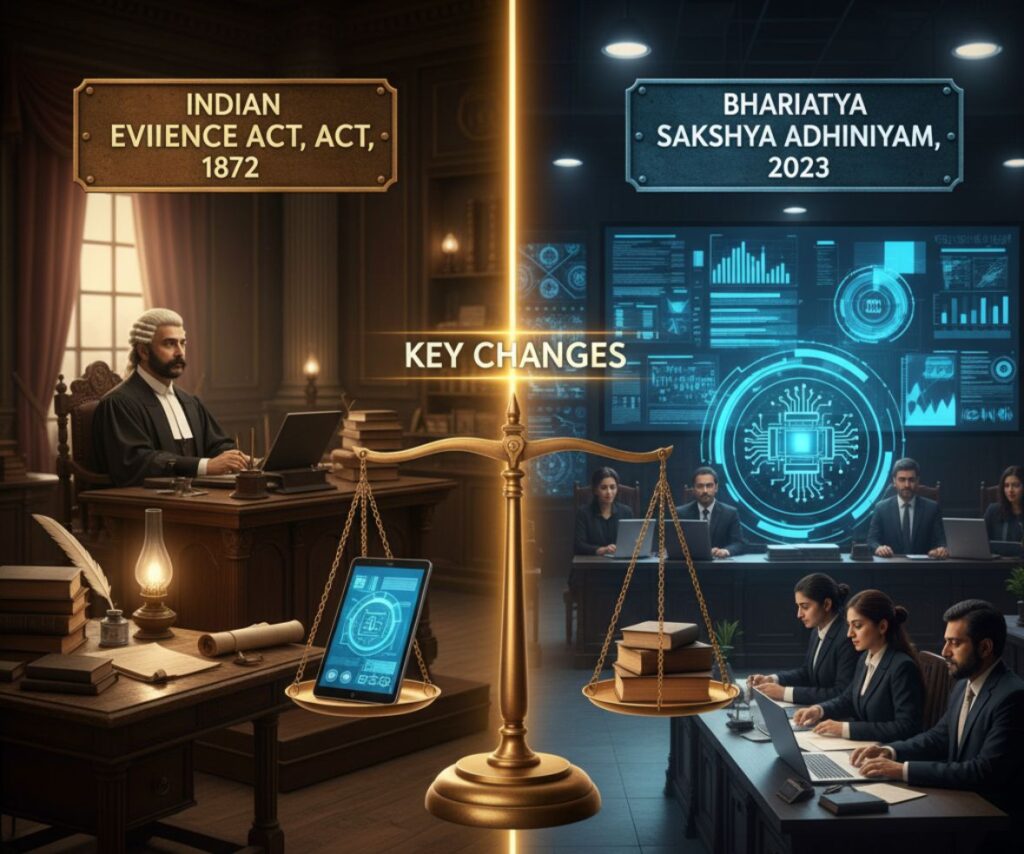
Key Changes from the Indian Evidence Act, 1872 to the Bharatiya Sakshya Adhiniyam, 2023
Introduction
The Indian proof Act of 1872 (IEA) has been one of the longstanding procedural statutes on the admissibility of evidence and assessment of evidence in courts of law in India. The IEA was a colonial statute that captured nineteenth century courtroom and technological realities, however as society evolved, consisting of the manner wherein crime is committed in a virtual international, it have become apparent that reforming the law of evidence become important. As such the Parliament of India passed the Bharatiya Sakshya Adhiniyam, 2023 (BSA), which went into impact on 1 July 2024, changing the IEA after 152 years of operation. The Bharatiya Sakshya Adhiniyam is meant to modernize evidentiary regulations, improve efficiency for courts, and adapt to the remedy of digital and digital proof. the overall standards and structure of the IEA were preserved whilst big and procedural amendments have been made. The BSA represents a substantial second of reform in India’s criminal justice device medicine along with the Bharatiya Nyaya Sanhita (BNS) and Bharatiya Nagarik Suraksha Sanhita (BNSS). this text will discover the primary distinctions between the IEA and the BSA, discussing how the reform may change judicial method, equity, evidentiary admissibility, and accused rights. key phrases: proof regulation, Bharatiya Sakshya Adhiniyam, legal Reform, electronic evidence, criminal Justice
Historical Background and Rationale for Reform
The IEA changed into passed amid British rule and designed round a paperwork-led manner below the colonial judiciary. through the years, Indian society has visible adjustments technologically, culturally and politically, however the law of evidence remained unchanged structurally. In fact, numerous issues arose from those changes:
• An growing dependence on virtual evidence: emails, CCTV, digital footprints, social media and cloud-primarily based statistics.
• growing complexity of cybercrime and prepared crime.
• bodily and handwritten documents being changed via electronic datasets.
• Inconsistent judicial interpretation of segment 65B for digital evidence. Committees, law commissions and the judicial system have diagnosed modernization of the law of evidence as critical. for this reason, the Bharatiya Sakshya Adhiniyam become handed to:
1. Simplify the language;
2. increase and clarify the regulations for digital evidence;
three. dispose of colonial terminology;
four. carry consistency amongst virtual and non-digital representations of evidence.
Structural Comparisons
| Feature | Indian Evidence Act, 1872 | Bharatiya Sakshya Adhiniyam, 2023 |
| Year Enacted | 1872 | 2023 |
| Total Sections | 167 | 170 |
| Terminology | Colonial legal language | Modern, simplified language |
| Approach to Electronic Evidence | Limited, scattered, reliant on case law | Detailed, structured, statutory clarity |
The BSA retains the three-part structure of the original law:
1. Relevancy of facts
2. Proof and effect of evidence
3. Production and examination of witnesses
However, wording has been refined for greater clarity and simplicity.
Key Substantive Changes
Expanded Definition of “Evidence”
The IEA described proof as either:
• Oral proof (orally communicated/folks that testified)
• Documentary evidence The BSA applies current varieties of communications to proof and especially identifies electronic and digital evidence at each of the 3 ranges.
• CCTV
• Voice notes
• Emails
• Chat logs
• statistics logs those are deemed to meet the priority stage of “primary evidence” no longer as a form of “substitutional” evidence. This marks the progression toward proof as a form of technology-centered judicial manner.
Certification of Electronic Records
it is Required one of the maximum controversial circumstances below the IEA turned into section 65B (certify is not always), specifically following conflicting occasions such as: • Anvar P.V. v. P.okay. Basheer (2014)—certifying is needed • Shafhi Mohammad v. country of Himachal Pradesh (2018)—there is no requirement to certify. • Arjun Panditrao Khotkar v. Kailash Gorantyal (2020)—the previous rule requires certification The BSA addresses this confusion: All digital information have to have a certificate that states where it comes from and that it has no longer been manipulated. The certificate needs to be from the “responsible person” in charge of the machine that shops the information. Reliability, traceability, and no manipulation.
Inference Deductions as it Relates to Digital Evidence
The BSA creates rebuttal presumptions that sure digital statistics produced from a relaxed technique are “actual,” such as: • virtual signatures • Blockchain verified • at ease servers’ information not eliminating scrutiny, it locations the preliminary burden of proof on the birthday party who is disputing that the evidence isn’t always authentic.
Documentation of Statements and Confessions
even though the general principle nonetheless holds that confessions made to the police aren’t admissible, the BSA updates procedure as follows:
• Statements and confessions can now be recorded the usage of audio-video generation.
• To restrict claims of coercion,
• increase transparency to the goodwill method,
• To shield both the accused and the police from false claims. that is steady with global trends toward digitally monitored investigatory practices.
Witness Examination & Provisions for Hostile Witnesses
The credibility of witnesses stays a bedrock precept of the criminal justice system. The BSA and BNSS together advise:
• greater protection for the identity of witnesses in sensitive conditions,
• plenty stricter penalties for purposely giving false testimony,
• Simplified procedures for labelling a witness hostile. that is especially applicable while intimidation is a issue, or reminiscences have dwindled and exceeded full-size time. impact of tactics on Courts, the Police, and legal professionals for Courts
• With an improved reliance on virtual files, trials might be faster to review, with a long way less reliance at the bodily office work.
• Judges will need to modify to decoding metadata, timestamps, and encryption, as well as authenticity features within the technology itself. For the Police
• Investigating entities will need technical schooling once they extract information digitally, and preserve continuity of proof altogether. For Lawers
• There might be a shift in defense/prosecution exploration of ongoing techniques to apply ‘digital trustworthiness’ as part of pass-examination.
prison training and expert schooling ought to evolve as a consequence.
Critiques and Issues
Although the objectives of the BSA are commendable, there are still obstacles:
1. Infrastructure Gaps: Not every police station offers crime-scene access to collect forensic evidence.
2. Digital Literacy Gap: Users in rural benches of lawyers and judges may have difficulty adapting.
3. Risks of Over Reliance on Digital: Records can be altered, and authentication will still need to be enforced, as the previous evidentiary act said.
4. Surveillance, Privacy & Data Protection: Increased electronic monitoring of citizens (and therefore attorneys and judges) raises the question of whether appropriate legal and/or technological safeguards for accountability of surveillance have been put into place. The success of the statute is not simply in the wording. The successful adoption will occur in the implementation of the BSA.
Key Case Laws on Electronic Evidence
1. Anvar P.V. v. P.K. Basheer (2014)
• Principle: The Supreme Court held that electronic records are admissible only if accompanied by a certificate under Section 65B of the IEA.
• Impact: This case created a strict requirement for certification, which the BSA later codified more clearly.
• Relevance to BSA: The Bharatiya Sakshya Adhiniyam now makes certification mandatory, resolving earlier judicial ambiguity Indian Journ….
2. Shafhi Mohammad v. State of Himachal Pradesh (2018)
• Principle: The Court relaxed the requirement of Section 65B certification, stating that if the party cannot produce the certificate, courts may still admit electronic evidence.
• Impact: This contradicted Anvar’s ruling, leading to confusion.
• Relevance to BSA: The BSA eliminates this inconsistency by requiring certification from the “responsible person” managing the electronic system Indian Journ….
3. Arjun Panditrao Khotkar v. Kailash Gorantyal (2020)
• Principle: A Constitution Bench reaffirmed Anvar’s strict requirement of certification under Section 65B.
• Impact: This settled the conflict but highlighted the need for legislative clarity.
• Relevance to BSA: The BSA adopts this position, ensuring uniformity and statutory clarity Indian Journ….
4. State (NCT of Delhi) v. Navjot Sandhu (Parliament Attack Case, 2005)
• Principle: The Court admitted electronic evidence (like call records) even without Section 65B certification, relying on oral testimony of service providers.
• Impact: This case showed early judicial willingness to accept electronic records.
• Relevance to BSA: The new law closes this gap by requiring formal certification and authentication thelegalquor….
5. Sonu @ Amar v. State of Haryana (2017)
• Principle: The Court held that objections to electronic evidence must be raised at the earliest stage; otherwise, they cannot be entertained later.
• Impact: Reinforced procedural discipline in handling electronic records.
• Relevance to BSA: Strengthens the chain of custody and procedural safeguards for digital evidence Indian Journ….
6. Tukaram S. Dighole v. Manikrao Shivaji Kokate (2010)
• Principle: The Court recognized audio recordings as admissible evidence, provided authenticity and accuracy are established.
• Impact: Expanded the scope of “documentary evidence” to include electronic formats.
• Relevance to BSA: The statute now explicitly includes voice notes, audio-video confessions, and digital recordings thelegalquor….
How These Cases Shape the BSA
• Consistency: Conflicting rulings under the IEA (Anvar vs. Shafhi Mohammad) are harmonized.
• Certification: Mandatory certification ensures reliability and reduces manipulation risks.
• Digital-first approach: Courts must now handle metadata, blockchain verification, and secure servers as part of evidentiary analysis.
• Transparency: Audio-video recording of confessions aligns with global best practices.
Conclusion
Moving beyond the Indian Evidence Act, 1872 to Bharatiya Sakshya Adhiniyam, 2023 is a momentous step in modernizing India’s evidential landscape. The new law continues the traditions of fairness and judicial reasons while adapting to the realities of the digital age. The BSA tries to enhance the confidence in judicial outcomes by formally acknowledging a legal status for electronic evidence, clarifying authentication guidelines, and allowing room in the system for transparency. However, substantive changes will take only institutions, Markedly, some training – education-in-a general sense-, and an understanding of what access means to the public, and to implement changes. As India enters a law where some evidence is becoming electronic evidence, the justice system must keep pace with the new reforms and changes and ensure both technological efficiency and Constitutional fairness.
References
1. Anvar P.V. v. P.K. Basheer, (2014) 10 SCC 473.
2. Shafhi Mohammad v. State of Himachal Pradesh, (2018) 2 SCC 801.
3. Arjun Panditrao Khotkar v. Kailash Gorantyal, (2020) 7 SCC 1.
4. State (NCT of Delhi) v. Navjot Sandhu, (2005) 11 SCC 600.
5. Sonu @ Amar v. State of Haryana, (2017) 8 SCC 570.
6. Tukaram S. Dighole v. Manikrao Shivaji Kokate, (2010) 4 SCC 329.
7. Indian Evidence Act, 1872, Act No. 1 of 1872.
8. Bharatiya Sakshya Adhiniyam, 2023, Act No. 24 of 2023, Ministry of Law & Justice, Government of India.