This Article is written by Akash Avthale from Savitribai Phule Pune University (SPPU), Pune. In this article he focuses ion the intersection of technology and law, particularly on digital evidence and cloud storage as relevant to contemporary legal proceedings under Indian law frameworks.
This Article is written by Akash Avthale from Savitribai Phule Pune University (SPPU), Pune. In this article he focuses ion the intersection of technology and law, particularly on digital evidence and cloud storage as relevant to contemporary legal proceedings under Indian law frameworks.
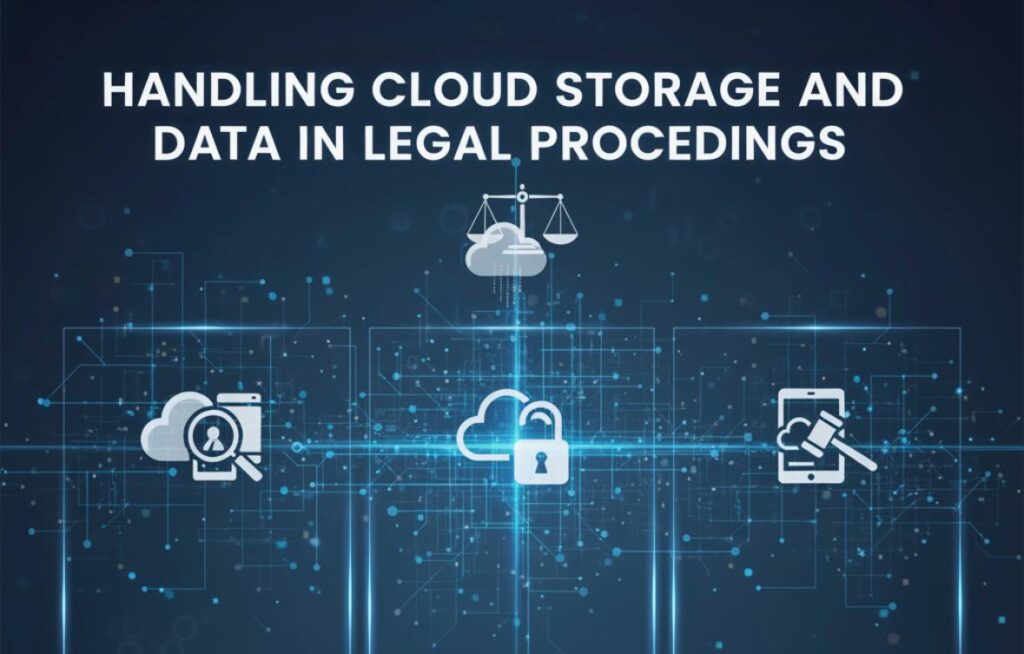
Handling Cloud Storage and Data in Legal Proceedings
This article critically examines the complex interplay between cloud storage technologies and legal proceedings within the ambit of Bharatiya Sakshya Adhiniyam ( BSA), focusing on how data stored on cloud platforms is dealt with and admitted into evidence in courts. The growth of cloud storage has radically changed the accessibility of data to assist lawyers as tools for maintaining case files, communications, and digital evidence. However, this shift in technology raises significant concerns about the integrity of evidence, protection of privacy, and observance of regulatory requirements, and the risks of cross border data storage.
This article examines the statutory regulations, fundamental legal principles, and best practices regarding cloud-based digital evidence, focusing on how Sections 57, 62, and 63 of the BNS/BSA address electronic records in multiple simultaneous originals, documentation of custody, and authentication requirements. It also shows how courts demand stringent chain-of-custody practices, technology-related safeguards such as data encryption, and the utilization of certified digital signatures to guarantee the admissibility and reliability of such evidence. The most recent case law and judicial opinions demonstrate that the interpretation of electronic evidence is constantly changing, as well as how best to certify information retrieved from cloud systems.
The paper highlights core concerns on privacy and data protection with technical solutions like encryption, access controls, audit logs, and regulatory compliance that secure client confidentiality and mitigate risks of unauthorized disclosure. Recommendations for legal practitioners range from the application of enterprise grade cloud solutions to following evolving legal standards.
Cloud storage
Cloud storage is a means of storing essential data and files on Internet servers maintained by third-party companies rather than keeping them on your computer or physical files. The technology has changed how lawyers and the courts handle case evidence and documents for the legal profession. Instead of carrying stacks of paper files, legal professionals can securely access and share digital files from anywhere at any time.
But cloud storage in legal affairs is not only a matter of convenience; it needs to be handled with care so that the data remains authentic, private, and legally valid in the courts. Laws like the Bharatiya Sakshya Adhiniyam (BNS) in India dictate how such electronic evidence, including on the cloud, is to be maintained and presented. For instance, it has to be established beyond doubt that the records have not been tampered with, and there should be adequate audit trails as to who accessed or altered the data.
Because cloud data resides in servers that are often at different locations, many times outside a country, there are also issues of privacy and jurisdiction. Legal professionals have to make sure that cloud providers use security measures such as encryption and authorized access controls to protect sensitive information from unauthorized use or breaches.
In sum, cloud storage indeed has many great benefits it can offer to the legal industry in terms of ease of access and management of data. It also introduces new challenges in understanding the relevant laws and finding appropriate technologies that will keep evidence reliable and secure in legal proceedings. This paper clearly illustrates these issues and how to handle cloud data properly during court cases according to current legal standards under the BNS framework.
Statutory Framework in Bhartiya Sakshya Adhiniyam, 2023
The Bhartiya Sakshya Adhiniyam, 2023, which replaced the Indian Evidence Act, has significantly modernized the rules concerning digital evidence. Key provisions related to electronic records are:
Definition of “Electronic Record” in Section 2(1)(d).
According to the Information Technology Act of 2000, the Adhiniyam has defined “electronic record” as any data, image, sound, or record which is created, saved, received, or transmitted in an electronic form, like computer-generated microfiche or microfilm.
Sections 61–65: Proof in Documents
The Bhartiya Sakshya Adhiniyam’s Sections 61 through 65 establish general guidelines for documentary evidence, with Section 65 particularly addressing the admissibility of electronic information.
Section 65: Special Provisions Relating to Electronic Records
Admissibility and Presentation of Cloud Data as Evidence :
Section 65 of the Adhiniyam outlines conditions under which an electronic record shall be considered admissible, replacing the old Section 65B of the Indian Evidence Act. The key components are:
- Integrity of the source: The device or system used to produce the record must have been operating properly.
- Regular use: The electronic record was made in the regular course of activities.
- Authentication: A certificate may be required to prove the origin and accuracy of the record.
Sub-section (4): Certificate of Authenticity
The certificate required by this sub-section, which is similar to Section 65B(4) of the Indian Evidence Act, must include:
- The electronic record’s identification
- An explanation of the production process for it
- Specifications of the device used
- Statement from the individual in charge of the operation
Unless the court is satisfied with alternative forms of proof, the evidence may be declared inadmissible if this certificate is not produced.
Relevancy of Electronic Records
Electronic documents may be relevant under a number of headings:
Admissions (Section 20): Audio recordings, WhatsApp messages, and emails might be accepted.
Electronic declarations submitted by missing or deceased individuals who are not able to be called as witnesses are covered under Section 26.
Digital ledgers, bank transactions, and server logs are examples of entries in electronic records maintained in the regular course of business (Section 27).
Digital photos and videos: Visual documentation of an event (Section 22).
Opinion of examiner of electronic evidence (Section 45A): Professional judgment regarding a digital file’s legitimacy.
Types of digital evidence
Below are the formats most commonly seen in Indian courts in 2025, with practical notes for collection and presentation.
CCTV
Export original clips from DVR/NVR with system time, camera ID, and frame rate preserved; compute and record SHA‑256 hashes on the original and working copies.
Maintain the device log (who exported, when, tool/version). Avoid lossy re‑encodes.
WhatsApp / Telegram chats
Prefer full chat exports from the platform or device instead of using screenshots.
In the accompanying certificate, include identifying details of the device—such as IMEI number, operating system, and build version.
Ensure that all media files and call logs are preserved along with their corresponding timestamps.
Emails & server logs
Obtain provider-generated exports that include complete headers, along with DKIM/ARC validation results and message IDs.
When asserting cases of impersonation or account compromise, retain all relevant audit logs such as mailbox access records and associated IP addresses.
Case law
State (NCT of Delhi) v. Navjot Sandhu (2005) 1 SCC (Cri) 02 255, 2005 SCC OnLine SC 417
The Supreme Court permitted computer-generated call records without a Section 65B certificate, holding that such evidence could be admitted under other sections also. But later on, this was reconsidered.
Arjuhttps://indiankanoon.org/doc/172105947/n Panditrao Khotkar v. Kailash Kushanrao Gorantyal(2020) 7 SCC 1
This Constitution Bench judgment reaffirmed Anvar’s interpretation. It laid down that:
A 65B certificate is required for admissibility. The certificate need not be brought on record during filing of the document; it may be brought on record later. If the original device is in the control of the adversary party or third party, the requirement of a certificate may be relaxed by the court.
Anvar P.V. v. P.K. Basheer (2014) 10 SCC 473
The Court ruled electronic evidence without a Section 65B certificate to be inadmissible, even if the original device is made available. This was a stricter application of the rules of admissibility.
” The law now prescribes that secondary substantiation in the form of electronic records must be furnished with an instrument under Section 65B (4) of the substantiation Act.”
FAQ
What is cloud storage in the legal context?
Cloud storage means keeping digital files and information on remote servers accessed via the internet and not exclusively on local computers. In courts, this facilitates the work of lawyers in storing, accessing, and sharing with the court case-related data in an easier and highly secure manner.
Is data from the cloud accepted as evidence in court?
Yes, courts can accept data stored in the cloud as electronic evidence. However, it must meet certain requirements to prove its authenticity and integrity. In India, the Bharatiya Sakshya Adhiniyam (BNS) and Section 65B of the Indian Evidence Act set out the rules for admitting digital evidence.
What are the major challenges in using cloud-stored evidence?
Challenges include ensuring data privacy, handling jurisdictional issues if data is stored abroad, and preventing tampering with digital records. Meeting strict legal standards for authenticity and certification can also be complex.
Reference
- Bhartiya Sakshya Adhiniyam, 2023 (BSA) by Ratanlal & Dhirajlal commentary
- Comprehensive amendments to criminal law by PIB (https://www.pib.gov.in/PressReleasePage.aspx?PRID=2001862 )
- Anvar P.V. v. P.K. Basheer & Ors. (2014) 10 SCC 473- https://indiankanoon.org/doc/187283766/
- Arjun Panditrao Khotkar v. Kailash Kushanrao Gorantyal (2020) 3 SCC 216 – https://indiankanoon.org/doc/172105947
- State (NCT of Delhi) v. Navjot Sandhu (2005 ) – https://indiankanoon.org/doc/1769219/