This article is written by Ammara Mehvish Shaikh, Government Law College, Mumbai.
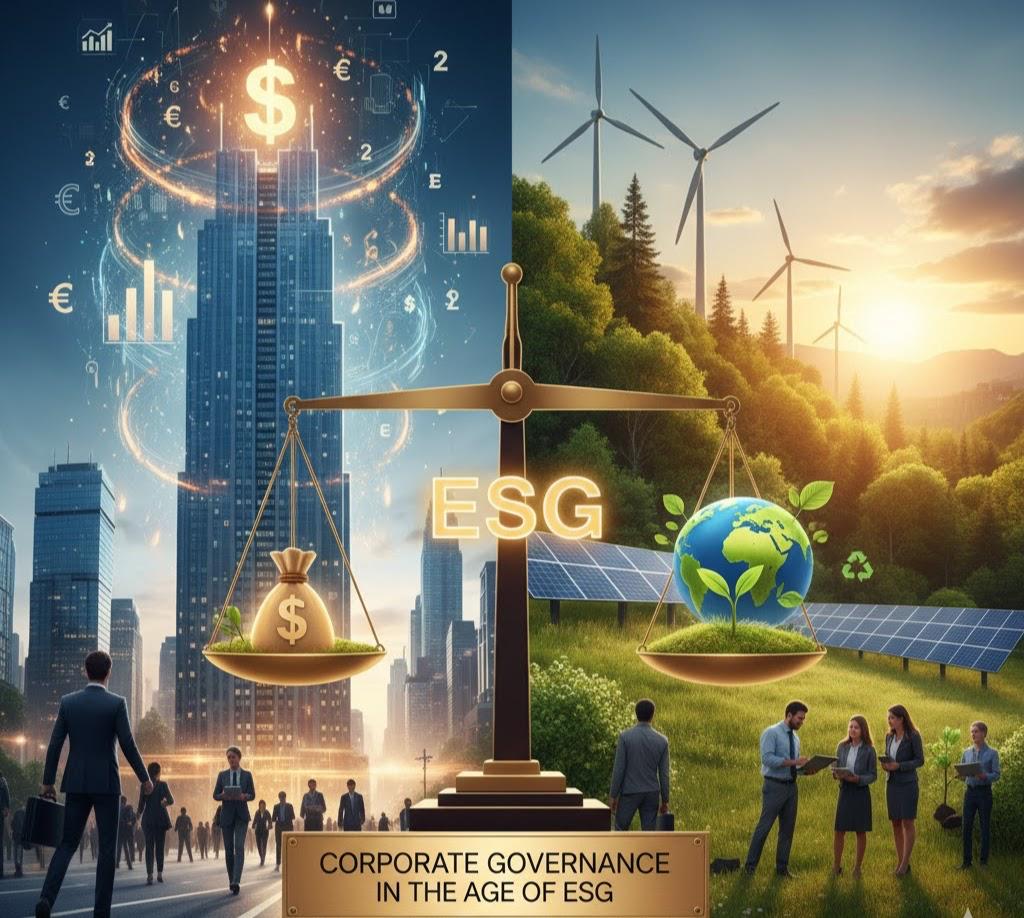
Corporate Governance in the Age of ESG: Balancing Profit and Sustainability
Corporate governance today is not just about board meetings or shareholder rights anymore, it’s more like this huge mix of ethics, environment, and accountability which all together form the new buzzword everyone talks about – ESG (Environmental, Social, and Governance). Now days it’s not enough for a company just to earn profit, it also have to show that it care for climate, for employees, for the people in general. Earlier, you know, companies only focused on making the shareholders happy but now they got to make the stakeholders happy too, like workers, society, regulators, and even the environment itself.
The ESG movement basically came out because of all the scandals and environmental disasters that exposed how badly some corporates were being run. Think about the BP oil spill, or the Satyam scandal in India, or the whole Vedanta Sterlite protests, those things made people realize that without strong governance, profits can destroy a lot. So ESG governance tries to bring sustainability as the heart of corporate planning, not just as some CSR add-on.
Also, investors today are more aware, they don’t just see balance sheets. They check sustainability reports, diversity numbers, carbon disclosures. In India too, SEBI have come up with rules for the top 1000 listed companies to file something called Business Responsibility and Sustainability Report (BRSR), which shows how much they are aligning their profit motives with ESG goals. So yeah, that’s a pretty big step towards making corporate governance more transparent and sustainable.
Corporate Governance and ESG: The Changing Dynamics
The old style of governance, like what used to be taught from Cadbury Committee Reports, was mainly about accountability to shareholders, but now, governance is something more like a balancing act. A company’s duty doesn’t end with profit distribution but goes further to ensure that the way profits are earned is ethical and sustainable.
Environmental part means companies have to look at their carbon emissions, waste management, energy use, etc. Social part means fairness to employees, gender diversity, no child labor, respect for human rights, and so on. And Governance is the structure that makes sure these things actually happen and not just printed in some fancy report.
Indian corporates are slowly realizing this change too. Like, Infosys and Tata Group have long shown leadership in sustainable governance. Tata Sons, for example, follows what Ratan Tata used to say — “businesses are not about making money only but improving life of people they serve.” This philosophy kind of reflects the ESG thinking before it became a global trend.
SEBI, the Companies Act 2013, and even NITI Aayog have started putting pressure for disclosure and social responsibility. Section 135 of the Companies Act made CSR spending mandatory for certain companies and even though CSR and ESG are different, still it shows that the government is pushing companies to care about more than profits.
Case Laws and Developments
Let’s be honest, there are not too many direct “ESG” cases in India yet because it’s still evolving, but there are many corporate law judgments that reflects the shift towards responsible governance.
In Tata Consultancy Services Ltd. v. Cyrus Investments Pvt. Ltd., (2021) 9 SCC 449, the Supreme Court dealt with corporate governance and the rights of minority shareholders after the removal of Cyrus Mistry as chairman. The Court, while upholding Tata Sons’ decision, emphasized that corporate decisions must not be arbitrary and must follow proper governance structure. Even though it didn’t say “ESG,” the whole idea of fairness, transparency, and accountability was there.
Then in M.C. Mehta v. Union of India, AIR 1987 SC 1086, the Supreme Court gave rise to the concept of absolute liability for environmental damage. That judgment, in a way, became a foundation for the “E” part of ESG — because it made it clear that corporates can’t hide behind excuses when they pollute or damage the environment.
Also, National Green Tribunal (NGT) cases like Sterlite Industries (2013) and LG Polymers (2020) show how environmental negligence leads to strict penalties and even closure of plants. This directly links to ESG accountability. If the governance system was strong inside those companies, maybe these disasters would not happen.
Globally too, cases like Shell Netherlands v. Milieudefensie (2021) where a Dutch court held Shell responsible for reducing its carbon emissions under the Paris Agreement goals, are examples where judiciary is making corporations accountable for climate and governance failures.
These cases reflect how judiciary and regulators are both shaping the governance landscape to fit ESG norms, even though sometimes the line between judicial intervention and corporate freedom becomes quite blurry.
Challenges and Criticism
Honestly, one of the biggest problems in India’s ESG and governance model is that sometimes it looks more like a checklist than a genuine ethical shift. Many companies just fill out the BRSR report for the sake of compliance. The data is vague, and not much penalty happens for fake disclosures.
Also, many Indian companies are family-controlled, so independent directors often are not that independent. There are situations where sustainability committees are made but they hardly meet or have any real authority.
And also the biggest issue is the profit-sustainability tension. Companies are under huge pressure to perform quarterly, meet shareholder expectations, etc., so when a choice has to be made between profit and ethical spending, ESG easily takes a backseat.
The global market also have inconsistencies — like western investors want green disclosures but at the same time they invest in oil or mining companies too, so the concept becomes a bit hypocritical at times.
In India, lack of ESG literacy among small investors and companies also slow down the movement. Sometimes, it’s only the top 500 companies talking about it while the rest are not even aware. So governance reforms must focus on awareness also, not just regulation.
Future of Corporate Governance in ESG Framework
The future of governance is definitely moving towards sustainability. With climate change, social justice, and ethical investing becoming mainstream, companies that don’t adapt may find themselves losing investor trust.
The Companies (Amendment) Bill 2020 also emphasized stakeholder engagement, data transparency, and director’s duties that include ethical oversight. SEBI is pushing BRSR Core, which will make ESG metrics more comparable and reliable.
If India wants to attract foreign investment, then it has to show ESG credibility because global investors are now screening portfolios for ESG risks. So the boards will need ESG experts, sustainability audits, and long-term strategies.
At the same time, we need to remember that ESG is not a burden, it’s an opportunity. Companies that have good ESG performance are already seeing better stock valuations and customer loyalty. For example, Infosys, Wipro, and HDFC Bank have ESG ratings that are among the highest in Asia.
But for this to be more than a trend, India needs strict enforcement of governance rules, protection for whistleblowers, and less political interference in regulatory bodies. Otherwise ESG will just become another CSR-like obligation that people forget after a few reports.
Conclusion
To sum it up, corporate governance today is entering a new age where ethics, sustainability and profit all need to walk together. ESG is not just a fancy word but a framework that can redefine what success in business really means. Companies like Tata, Infosys, and Mahindra have shown that doing good and doing well can co-exist.
Still, a lot of work is needed to make ESG real and not just symbolic. Boards need to be more diverse, investors more informed, and regulators stricter. The challenge is to find the right balance between sustainability and shareholder expectations. Because end of the day, a company that ignores environment or social justice can’t survive long even if it makes temporary profits.
Corporate governance with ESG at its heart is the only way forward for modern India — to make growth not just profitable but responsible too.
FAQs
What does ESG stand for in corporate governance?
ESG means Environmental, Social, and Governance — basically the 3 pillars of responsible business conduct that companies now need to focus on besides just profits.
How is ESG different from CSR?
CSR is about spending part of profits for social causes, while ESG is about how a company earns those profits ethically and sustainably through its core business.
Is ESG mandatory in India?
SEBI has made ESG reporting mandatory for top 1000 listed companies through the Business Responsibility and Sustainability Report (BRSR).
Why is ESG important for investors?
Because investors now use ESG ratings to evaluate risks like pollution, litigation, governance scandals etc. So it affects brand image and stock prices too.
What is the main challenge for ESG in India?
The main issue is the gap between policy and practice – companies disclose ESG but don’t always follow it genuinely, plus limited awareness and inconsistent enforcement.