This article is written by Jashleen, 3rd-year student of Chandigarh University. This article is written by Jasleen, who aims to highlight the silence surrounding marital rape in India. Through this piece, she seeks to bring awareness to the urgent need for legal recognition and protection for victims.
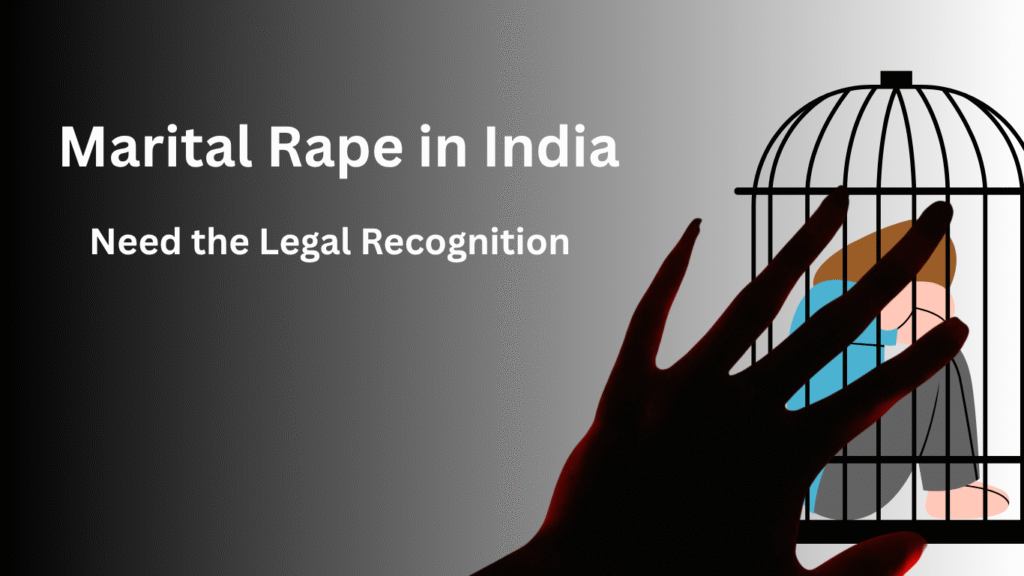
Marital Rapes In India: Need For Legal Recognition
Marriage is considered a sacred bond and union of two souls, built on mutual trust, self-respect and autonomy and consent. This implies that both partners have a right to give or withhold consent in every aspect of their marital relationship, especially in the case of physical intimacy. As per patriarchal and cultural norms, women’s consent is ignored, or even in some cases, from an early age, women are taught to keep mum and be always available to their husbands sexually, and not to resist them.
However, marital rape clearly violates these basic yet essential elements of a marital relationship. Marital rape refers to a situation in which a partner forces sexual intercourse on the other, clearly violating the victim’s autonomy, dignity and self-respect. In the case of marital rape, the perpetrator is the husband of the victim.
There is a stark contrast between the social realities lived by the victim, where a woman is not even safe with the partner from whom she is expected to seek a sense of security and assurance in her marital home.
LEGAL STATUS OF MARITAL RAPE IN INDIA
India is amongst the thirty-six countries that still have not criminalised marital rape.
Section 63 of the Bhartiya Nyaya Sanhita 2023 defines rape clearly exempts marital rape
63. Exception 2-. Sexual intercourse or sexual acts by a man with his own wife, the wife not being under eighteen years of age, is not rape.
Even after witnessing many cases of marital rape, the newly enacted criminal laws in India haven’t properly acknowledged marital rape under Section 63. The core element that distinguishes it as rape is the absence of voluntary consent, irrespective of the marital relationship.
Several petitions have been filed in the Supreme Court regarding the criminalisation of marital rape. This also violates the very fundamental rights given to every citizen under Article 14 , Article 15 and Article 21 of the Indian Constitution.
In the landmark judgement of “Independent Thought v U.O.I, 2017”, the provision of raping a minor wife between the ages of 15-18 years was criminalised under the (Prevention of Child From Sexual Offences). However, the wives above the age of 18 years were still exempted. And petitioners continued to challenge this exception. Even the Union government has also filed an affidavit to remove the exception given to marital rape under exception 2 of section 63 in the ongoing Supreme Court case “Hrishikesh Sahoo v State of Karnataka” filed in 2017.
SOCIETAL AND CULTURAL CONTEXT
Indian society is deeply rooted in a patriarchal mindset, showing male dominance over their partners, showing marriage, which was considered a sacred and equal bond in ancient India, now as a symbol of power, superiority and hierarchical inheritance.
The old age customs of dowry and kanyadaan, and husband being referred to as “pati-parmeshwar” in Indian marriages, present women as a piece of property being transacted from her father to husband and showcase the dominance of husband over the wife.
This also normalises the authority of the husband over the wife’s decision-making power and body, including sexual decisions. supporting the idea of women being submissive to their husbands’ desires, irrespective of their own consent.
There is a stigma to discussing sexual violence within marriage, particularly marital rape, due to fear of societal taboos, fear of being judged, fear of dishonour and economic dependence on their spouses.
This silence fosters non-consensual sex within marriages. Marital rape causes a threat to women’s dignity, autonomy and also has a profound effect on their mental health, causing trauma as well.
ARGUMENTS AGAINST THE RECOGNITION OF MARITAL RAPE
One of the primary arguments is that the criminalisation of marital rape would harshly affect the sanctity of marriage. Believing that marriage is too pure and sacred to be interfered with by criminal interventions, where it is assumed that there is mutual sexual consent between the spouses. Many also argued that interfering with a couple’s marital relations would disrupt the very institution of marriage.
Many argued that continued interference in family matters and recognising marital rape legally would affect the stability of society.
Another argued that there already exist legal provisions providing sufficient protection to women from sexual offences in their married lives. The protection of women from domestic violence recognises sexual abuse as a form of domestic violence, providing remedies.
A few religious groups also asserted that there is implied consent for sexual relations through marriage. This belief reinforces resistance to criminalisation, often overshadowing women’s autonomy and consent
Summarising the arguments, the main concern of the opponent is basically regarding disturbing the social stability, harming the sanctity of marriage and the concerns of misuse and misappropriation of the provisions.
CRITICAL ANALYSIS OF CURRENT LAWS AND REMEDIES ON MARITAL RAPE
INDAIN PERSPECTIVE
There are significant limitations in the Indian statutory provisions with respect to the legal recognition of marital rape in the Protection of Women from Domestic Violence Act,2005.
The (DV Act), 2005, recognises sexual abuse within marriage as a form of domestic violence. Offering civil remedies such as protection orders, residence rights, and monetary relief. However, the DV Act does not criminalise marital rape explicitly, and survivors cannot initiate criminal proceedings solely for non-consensual sex within marriage under this law.
The current laws face shortcomings in specifically providing redress for marital rape. The limited civil remedies under the DV Act cannot replace the deterrent effect of criminal law, and the marital rape exemption in BNS institutionalises impunity for perpetrators.
For survivors, lack of access to effective justice, continued violation of fundamental rights, and social stigma that discourages reporting.
INTERNATIONAL PERSPECTIVES
Marital rape has been criminalised in 77 countries worldwide, while 74 countries accept cases of marital rape under the discrimination and gender centric laws, while 34 countries, including India, Jordan have still not criminalised marital rape.
In western countries like the USA, Canada, marital rape is treated as non-marital sexual assault, emphasising the need for consent within marriage and highlighting the women’s dignity, freedom and the equality of the partner in the marriage.
The United Kingdom and Sweden have progressive laws against marital rape, awarding strict punishments to the perpetrator, recognising the autonomy and the individuality of a person, irrespective of their marital status, and mitigating the social stigma.
India, according to commitments to the “UN Sustainable Development Goals”, has a responsibility to uphold women’s rights to bodily integrity and protection from violence. This continued exception of marital rape contradicts the commitments and is expected to align with the nations globally advocating for gender equality and the criminalisation of all forms of sexual violence.
Hence, India is facing pressure to align its laws with global standards by criminalising marital rape, fulfilling both constitutional mandates and international human rights obligations, thereby ensuring much-needed protection and justice for women within marriage.
ADVOCATING FOR THE LEGAL RECOGNITION OF MARITAL RAPE
Criminalising marital rape aligns with fundamental rights guaranteed under the Indian Constitution. Article 14 (right to equality), Article 15 (prohibiting discrimination), and Article 21 (protects life and personal liberty). Marital rape violates these rights by denying women equal protection and infringing their right to life with dignity.
Human rights activists advocated that consent is central to any sexual act, regardless of marital status. Marriage does not grant irrevocable, blanket consent to sex; believing consent must be freely given and can be withdrawn anytime. Non-consensual sex within marriage is a violation of bodily autonomy and an infringement of human dignity that must be criminally sanctioned to ensure justice for survivors and to dismantle patriarchy’s grip on women’s rights.
Women become the victims of marital rape on an everyday basis, while some of them get reported, while the majority get buried within the four walls of the house, because if the fear of dishonour and social stigma.
And victims of the cases being reported do not generally receive the justice they deserve. And the sole reason for this is that marital rape is being outlawed.
Even in 2013, the Justice J.S. Verma Committee recommended the removal of exception 2 of section 375 of I.P.C., 1872, now section 63 of BNS, 2023, that makes marital rape, for wives over a certain age, not a crime.
Following this, in 2015, another committee under Pam Rajput suggested criminalising marital rape in India and criticised the government for not incorporating the Verma Committee’s suggestions.
Criminalising marital rape is imperative from constitutional, human rights, and pragmatic perspectives, recognising the fundamental right of women to bodily integrity and equality, offers justice to survivors, and addresses significant social and health consequences caused by the prevailing legal vacuum.
LEGAL REFORMS
These reforms are critical for ensuring justice, protection, and equality for women in India.
- Repeal the marital rape exemption under Section 375 IPC (now Section 63 BNS) to criminalise non-consensual sex within marriage
- Amend domestic violence laws to include criminal sanctions specifically for marital sexual violence.
- Define consent clearly as continuous, voluntary, and revocable in legal provisions.
- Establish survivor-centric judicial and police procedures, with gender-sensitivity training.
- Strengthen civil remedies, including easier divorce, protection orders, and restitution rights.
- Create specialised support services like crisis centres and counselling for survivors.
- Promote public awareness campaigns to change societal attitudes and reduce stigma relating to marital rape.
CONCLUSION
Criminalising marital rape is vital to uphold women’s constitutional rights to equality, dignity, and bodily autonomy. It challenges patriarchal norms that condone sexual violence within marriage and fills legal gaps, leaving survivors unprotected.
Comprehensive reforms, coupled with public awareness and survivor support, are essential to ensure justice and transform societal attitudes, paving the way for true gender equality in India.
FAQs
What is marital rape?
Marital rape occurs when a husband forces his wife into non-consensual sexual intercourse or acts, violating her bodily autonomy and dignity.
What challenges do survivors face in reporting marital rape?
Survivors face social stigma, economic dependence, fear of disbelief, and legal barriers due to the marital rape exception, hindering access to justice.
How prevalent is marital rape in India?
Surveys like NFHS report that 6 out of 10 married women face forced sexual acts by husbands, but most cases go unreported due to stigma and lack of legal protection.
What social challenges prevent recognition of marital rape?
Patriarchal norms, stigma, and the belief in implied consent within marriage discourage reporting and hinder legislative reform.
REFERENCES
- Report Justice. J.S. Verma Committee 2013 ( https://xn--i1b5bzbybhfo5c8b4bxh.xn--11b7cb3a6a.xn--h2brj9c/sites/default/files/2022-09/JS-VermaCommittee-2013_2%5B1%5D_0.pdf )
- Pam Rajput Committee, 2015 ( https://www.pib.gov.in/newsite/PrintRelease.aspx?relid=123390 )
- India’s commitment to United Nation Development Goals ( https://thelawbrigade.com/constitutional-law/protection-of-womens-rights-and-dignity-a-social-responsibility/ )